
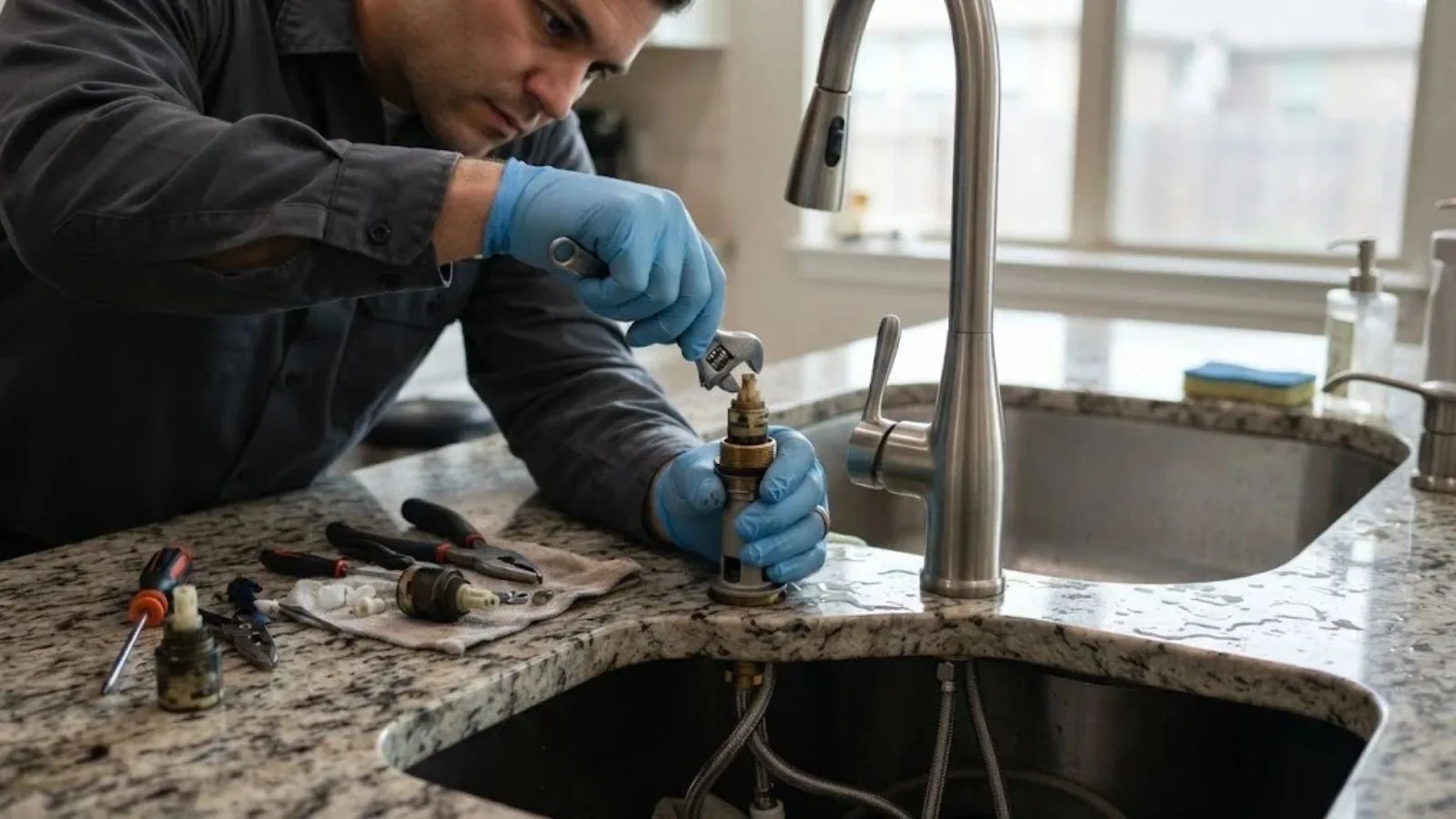
A bathroom sink that drains slowly without a hard clog is usually blocked by hair and soap scum wrapped around the pop-up stopper or sitting in the tailpiece and P-trap. Lift out the stopper, clean it, then clean the trap with a bucket underneath. If the sink still drains slowly, or the tub or shower nearby is slow too, the problem is in the shared branch line, and a plumber should clear it with the proper equipment. Talk to dispatch if the problem is happening now.
Start at the stopper and pivot rod
Most bathroom sinks use a pop-up stopper. A rod behind the faucet connects through a small pivot rod to the stopper, which lifts and drops to open or close the drain. Even when the stopper is open, its body and the pivot rod sit in the water path.
Hair catches on the pivot rod below the drain opening. Soap then glues the hair into a mat that slows water without ever fully blocking it. That is the classic case where a plunger finds nothing, yet the sink takes minutes to empty.
If the stopper does not rise or seal, a worn pivot nut or bent rod may be the reason. Faucet and fixture repair covers these small parts, which are simple to replace.
Hair, soap scum and the tailpiece
Below the stopper, the drain tailpiece is the short pipe running down to the trap. Soap scum, toothpaste, and shaving residue coat the inside, and over months the opening narrows. The sink drains, just slowly.
The overflow channel, the small hole near the rim, also carries water to the same tailpiece. If that channel is coated with slime, the sink may smell even though the drain looks clear.
Use a flashlight to look down the drain. A bright, clear tailpiece means the narrowing is probably lower. Gray film or matted hair means a cleaning will likely help.
A quick way to find which part is slow
Run two timed tests. First, fill the basin with the stopper closed and let it drain with the stopper open. Note how long the last inch takes. Second, remove the stopper entirely and repeat.
If the drain speeds up a lot with the stopper out, the stopper and pivot rod are the main restriction. If it barely changes, the narrowing is lower, in the tailpiece, trap, or beyond.
Pay attention to the sound. A steady swirl is normal. A slurping or gulping noise means air is being pulled through the trap, which points toward the vent or branch line instead of the sink.
Basic cleaning with common tools
Work from the top down and keep a bucket and towel nearby.
Lift out the stopper
Pull the pivot rod nut behind the tailpiece, slide the rod free, and lift the stopper out. Wipe off hair and gunk with a paper towel.
Clean the tailpiece and overflow
Scrub the visible drain walls with an old toothbrush and dish soap. Flush the overflow hole with hot water.
Open the P-trap
Set a bucket under the trap, loosen the slip nuts by hand or with pliers, and lower the trap. Empty it and clean the inside.
Reassemble and test
Tighten the slip nuts by hand, then a quarter turn with pliers. Run water and look for leaks at both ends.
Repeat the fill test
Fill the basin, pull the stopper, and time the drain. If it still takes far longer than it should, you are done with the sink.
Signs the trouble is below the sink
These clues say the stopper and trap are not the whole story.
- The tub or shower drains slowly in the same bathroom.
- The toilet bubbles or its water level dips when the sink empties.
- The sink gurgles after a toilet flush.
- A floor drain in the basement below smells or shows moisture.
- The sink drains well for a day after cleaning, then slows again.
- Every bathroom on the same floor drains a little slower than it used to.
Stop here and call a plumber
Stop if the trap and tailpiece are clean and the sink still drains slowly, if the nearby tub or shower is also slow, or if gurgling comes from any drain in the bathroom.
Also stop if you see leaks at the slip nuts that do not stop after retightening, corroded metal, or pipe that crumbles. At that point a drain cleaning visit with a small machine can reach the branch line your hand tools cannot.
When slow means a branch line problem
Bathroom sinks often share a drain branch with the tub, shower, or toilet. Water from the sink joins that branch a short way from the wall. If the branch is narrowed by hair, soap, or a root-invaded joint, the sink slows even with a clean trap.
Signs include a tub that rises while the sink empties, a toilet that bubbles after the sink drains, and a slow drain that returns right after cleaning. A nearby vent can add to the problem, since the same vent often serves the whole bathroom group.
A plumber can clear the branch through a cleanout or a trap arm and, if needed, scope it with a camera. Homeowners in Princeton and South Brunswick face the same branch-line logic, though each town has its own building office and sewer arrangements.
Fixture swaps and permits for a bathroom sink, Plainsboro, NJ
Cleaning a trap is maintenance. Replacing a sink or its drain parts can fall under state rules. N.J.A.C. 5:23-2.17A lists new installation of fixtures in existing space as minor work, if there is no increase in the size of the water distribution system, water service, or house drain.
Minor work still needs notice to the local enforcing agency before it starts. In Plainsboro that is the Building Division on Plainsboro Road, whose permit page lists Plumbing as one of its subcode sections.
Only a master plumber, an authorized plumbing contractor, or their W-2 employees may do plumbing work in NJ. For anything beyond cleaning, check the plumber on the Division of Consumer Affairs License Verification System. Plumbers size and vent bathroom drains to New Jersey's plumbing subcode, the National Standard Plumbing Code, which is why a sink that gurgles may point to a venting problem and not only a clog.
Where this comes from: N.J.A.C. 5:23-2.17A text, township Building Division permit page and NJ Division of Consumer Affairs licensing page.
Questions readers ask
Hair and soap scum on the stopper, tailpiece, or trap narrow the pipe without blocking it. A thorough cleaning from the top down usually helps.
Chemical cleaners can damage the stopper seal and metal parts, and they can splash. Mechanical cleaning is safer, and a plumber should handle anything deeper.
Place a bucket underneath, hand-loosen the slip nuts, and lower the trap straight down. Do not force corroded nuts. Cracking them can turn a simple job into a plumbing call.
Pulling the stopper and wiping out the hair and film every few months keeps the drain open. Homes with long hair in the household may need it more often.
The sink and tub likely share a branch line that is partly blocked. This is a branch line problem, not a stopper problem.
State rules treat like-for-like fixture installs in existing space as minor work, which still needs notice to the local enforcing agency. Ask the township Building Division on Plainsboro Road before you start.
Most slow bathroom sinks are trouble at the stopper or trap, but a few are really a branch line problem.
Call (609) 547-1417Where we dispatch from
Our plumbers work across Plainsboro and the neighboring towns on the map. Our base is 777 Scudders Mill Rd, Plainsboro, NJ 08536, and the map shows the surrounding towns we serve.