
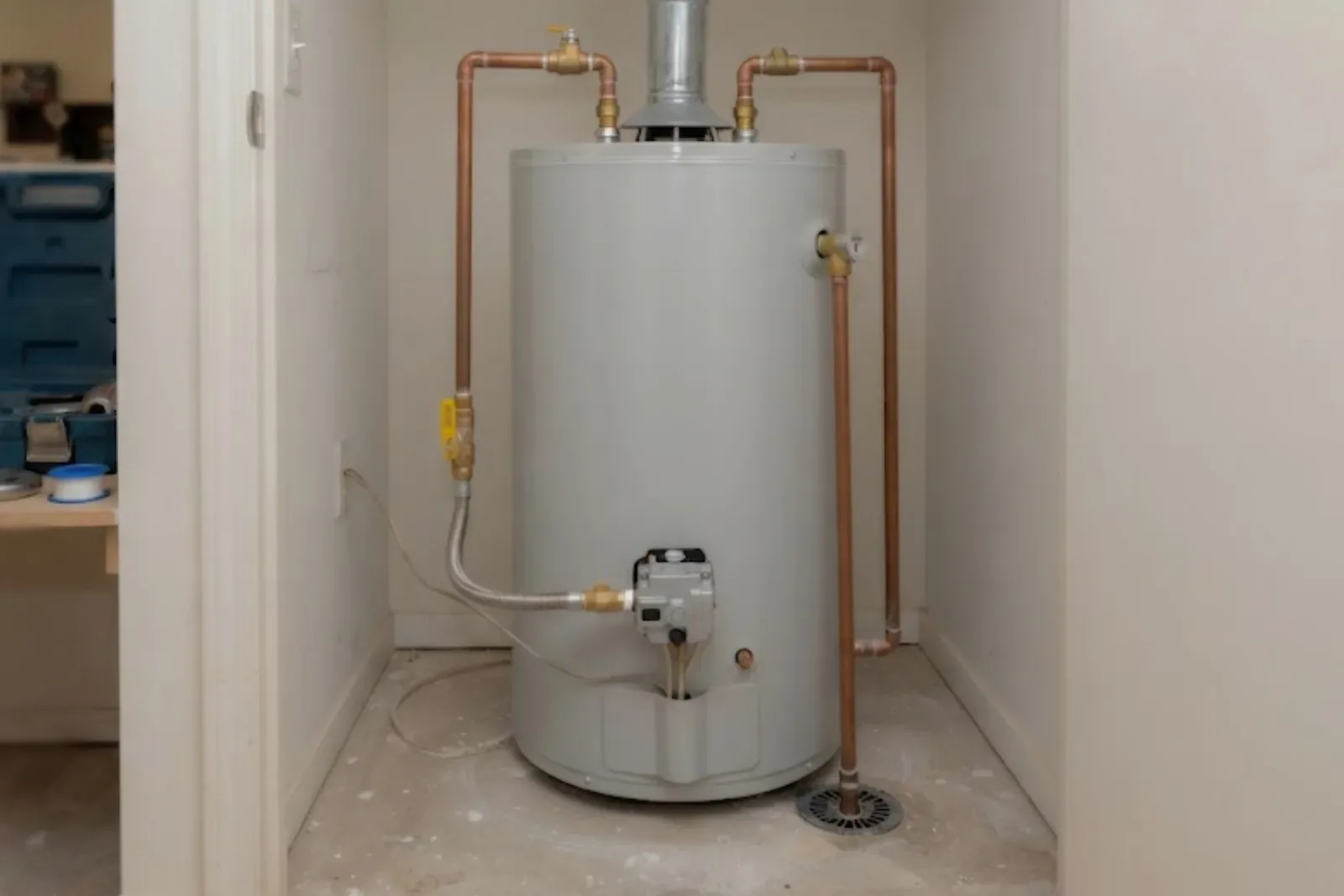
A failed tank forces a choice today, and water heater replacement in Plainsboro starts with a phone call to the 24/7 line. While you wait, shut the cold supply valve on top of the tank, turn off the breaker or set the gas control to off, and mop up standing water so it does not reach drywall or a finished floor.
The old tank has failed, so the useful questions are about the next one. Should it match the old unit exactly, or is this the moment to change the size or fuel? Who files the paperwork with the township? And if you live in a condo or rent, who has to say yes before anything is installed? This page walks through each decision in the order you will meet them.
Tank gone tonight: how a same-day swap usually unfolds
Once a plumber confirms the tank itself has failed, a like-for-like swap is usually a half-day job when the new unit is on hand. The old tank is drained, disconnected, carried out and replaced, then the new one is filled, vented and tested before it is lit or powered.
Not every size or fuel type is on a truck at night. If the exact match is not available after hours, a plumber can sometimes set a smaller temporary unit or arrange a morning delivery. Ask for that option when you call, and expect a clear price before work starts.
The same after-hours process applies if you live just over the line in West Windsor. If water is still flowing from a pipe rather than the tank, that is a job for burst pipe repair.
Match it or change it: the first decision
A like-for-like swap keeps the same fuel, the same capacity and the same location. It is the quickest route and the lightest on paperwork, because the venting and gas or electrical supply already fit. For many homes it is also the right answer.
Change the unit when the family has outgrown it, when the old heater was too big or small to begin with, or when you want lower running costs. Moving from gas to electric, or from a standard tank to a heat pump unit, can add venting, electrical or gas work. At that point the job moves toward a planned water heater installation rather than a straight swap.
Tank, tankless or heat pump: what the swap really changes
Service life figures are from the US Department of Energy. The rest is what installers see in the field.
| Type | Service life (DOE) | What changes at install |
|---|---|---|
| Storage tank, gas. | Ten to fifteen years. | Same vent and gas line in most swaps. Check the flue and sediment trap. |
| Storage tank, electric. | Ten to fifteen years. | Often the simplest swap. The circuit and breaker must match the unit. |
| Tankless, gas. | About twenty years. | Needs larger gas line, special venting and a condensate drain for condensing models. |
| Tankless, electric. | About twenty years. | Needs heavy-gauge circuits, sometimes a panel upgrade. |
| Heat pump (hybrid). | Check the maker's listing. | Needs space, airflow and a condensate drain. See tankless water heater for the on-demand alternative. |
DOE lists the heat pump class separately from storage tank and tankless. Confirm the life and warranty on the specific model.
Sizing the new heater to the people in the house
Tank size is a first-hour rating question, not just a gallon count. The first-hour rating is how much hot water the unit can deliver in the first hour of heavy use, and it is printed on the yellow energy label. A family that runs two showers and a dishwasher at the same time needs a higher rating than a couple.
Count peak demand: bathrooms, soaking tubs, a laundry load at the same time as showers. If you are replacing an old tank that always ran out, do not copy its size. If it never ran out, matching it is a safe bet.
DOE says 120 F is adequate for most households. A larger tank set at 120 F is usually a better fix for a big family than a smaller tank turned up high.
Before you say yes to the quote
Ask these questions of any installer, including us.
- Is the new unit the same capacity and fuel, or does anything change?
- Who files the township notice and permit application?
- Will the old tank be drained, removed and taken away?
- Is a new expansion tank, relief valve, drain pan or flex connector included?
- Does the venting or gas line need changes to meet current code?
- What is the warranty on the tank and on labor, in writing?
- Is the installing plumber's license current? You can verify it through the NJ Division of Consumer Affairs License Verification System.
Expansion tank, relief valve and venting in plain terms
When water heats, it expands. In a closed plumbing system with a backflow device or pressure reducing valve, that extra volume has nowhere to go and pressure spikes. A small expansion tank on the cold line absorbs it. If your old heater had no expansion tank and you had dripping relief valves, that is a clue.
The temperature and pressure relief valve is the safety device. It must have a discharge pipe pointing toward the floor or a drain, never capped. On gas heaters, the vent carries exhaust out of the building. Rust at the draft hood, soot or a scorched look near the top means the vent needs inspection before the new unit is lit.
These are reasons a plumber should be doing the work, and also reasons a swap is not simply unplug and plug.
What happens on the day of the swap
A standard tank change follows a fixed order, which is also how an inspector will look at it.
Shutoff and drain
Water, power or gas are shut off, and the old tank is drained to a floor drain or outside with a hose.
Disconnect and remove
Supply lines, vent and gas or electrical connections are disconnected, and the old tank is carried out and hauled away.
Set and connect
The new tank is set on a pan or stand, with new flex connectors, a relief valve discharge pipe and a fresh expansion tank where needed.
Fill and purge
The tank is filled and air is bled from a hot tap before power or gas is turned on, so elements are not run dry.
Test and inspect
Combustion, venting, gas joints and relief valve are checked, and the township inspection is requested.
Plainsboro's permit path for a replacement
Plainsboro's Building Division page says permits are needed for maintenance items such as water heater replacements. Under N.J.A.C. 5:23-2.17A, replacing a heater with a new one of like capacity counts as minor work. The owner or contractor gives notice to the local enforcing agency before starting, then files a permit application within five business days, and an inspection follows.
That is not a permit exemption, so a quote that says no paperwork is needed should raise a question. If the capacity changes, or the swap needs new venting or gas work, ask the local construction office on Plainsboro Road before work begins.
In the 1970s and early 1980s Plainsboro was dominated by multifamily building, and Princeton Meadows has thousands of residential units, many of them condos and townhomes. Many of those units sit in closets with shared walls and shared vents. Check your association rules before authorizing any work, because some require approval for the heater type and the contractor. Walker-Gordon, the 1988 residential area, mixes single-family homes with patio homes on small lots where space around the heater is tight.
What drives the cost of a new water heater
A swap is rarely priced by the tank alone.
Tank type and size
Larger tanks, condensing gas units and heat pump models cost more than a standard electric or atmospheric gas tank.
Changes to venting, gas or electric
A different fuel or a power-vented unit adds materials and labor beyond the tank.
Code items
Expansion tank, drain pan, relief valve piping and sediment trap are added where the code or the setup calls for them.
Permit and inspection
Township fees are separate from labor and vary with the municipality.
Timing
Same-day or after-hours installs carry more dispatch cost than a booked weekday slot.
Homeowners insurance usually pays for resulting water damage from a sudden tank failure, not for the cost of the new tank itself. Rent or condo coverage differs, so ask your insurer before cleanup and keep photos and the old unit's label.
Call the 24/7 line and get a clear price for a like-for-like swap and for any upgrade before work starts.
Call (609) 547-1417Water Heater Replacement questions from Plainsboro homeowners
Yes. The 24/7 line takes calls at any hour, and a licensed plumber is dispatched for failed tanks. If the exact unit is not on the truck, ask about a temporary option or a first-thing-morning install.
Water from the tank seam or a rusted-through base means the inner tank is gone. If the leak is at a fitting or valve, water heater repair may be cheaper than a new unit.
Yes. The township page says permits are needed for water heaters. For a like-for-like swap the state minor work rule means notice before work and an application within five business days.
Technically yes, but tankless often needs bigger gas lines, new venting or electrical work. Many people get a tank now and plan a tankless upgrade later.
Many associations have rules on the heater type, the vent route and who may do the work. Check your association rules before you sign anything, and ask your management company about common-area shutoffs.
The plumber drains, disconnects and removes it. Ask that disposal is included in the price so you are not left with a tank in the garage.
The US Department of Energy puts a storage tank at ten to fifteen years and a tankless unit at about twenty. Flushing and an anode rod check extend the tank's life.
Tank failed? Get the swap booked
Call the 24/7 line and a licensed plumber will confirm the size, fuel and township notice.
Where we dispatch from
We send water heater replacement crews across Plainsboro and the neighboring towns. Our base is 777 Scudders Mill Rd, Plainsboro, NJ 08536, and the map shows the surrounding towns we serve.