
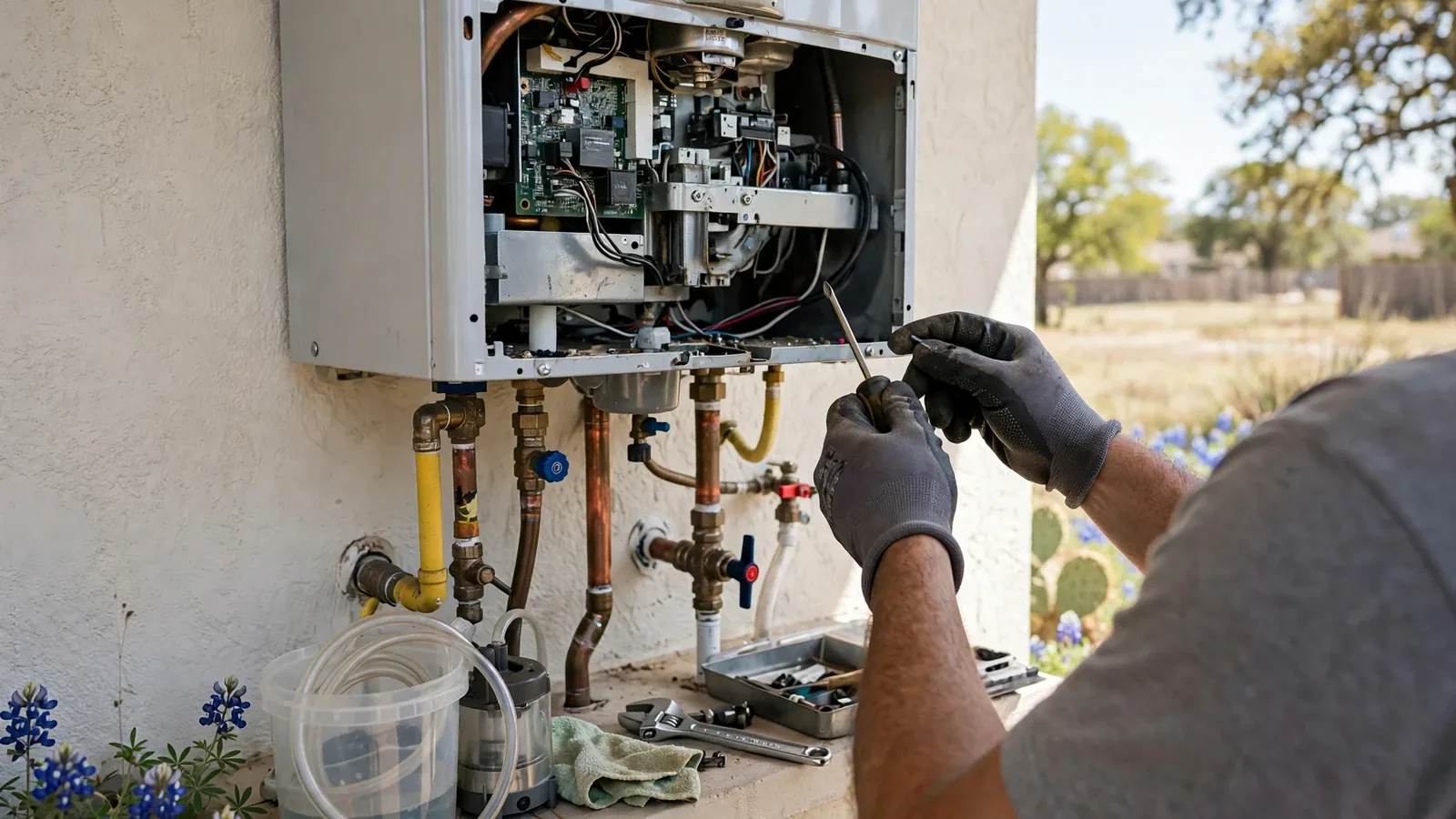
People who search for a tankless water heater in Plainsboro rarely start with the model. They start with a sentence: it needs a cleaning, it shows an error code, it has been years since anyone looked at it, or someone said they only replace them. Each of those has a plain meaning, and most are fixable.
A tankless unit heats water as it flows, so it has no standby tank to run out. It also has narrower passages, more sensors and tighter requirements for gas, venting and flow. This page covers the three jobs that matter: installing one properly, repairing one that has stopped behaving, and keeping it from scaling up.
What you heard, and what it usually means
These are the common phrases from homeowners, matched to likely causes.
| What you noticed or were told | Likely meaning | Sensible next step |
|---|---|---|
| It needs a cleaning. | Scale on the heat exchanger or a clogged inlet filter. | Check the manual, then have it flushed or descaled. |
| It shows an error code. | A sensor, ignition, flow, vent or scale fault, depending on the code. | Look up the code in the manual. If it repeats, call for service. |
| It has been years since anyone looked at it. | Missed flush and filter cleaning. | Have a plumber inspect it and flush it. |
| Someone said they only replace them. | The person may not service tankless units. | Ask for a diagnosis. Repair is often possible. |
| Hot, then cold, then hot again. | Cold-water sandwich effect or low flow. | Run longer, and ask whether a buffer tank or setting change helps. |
| Hot water takes forever to arrive. | Long pipe run, not the heater itself. | Ask about a recirculation loop or a point-of-use unit. |
Why the flush has its own section
Minerals in tap water form scale inside a tankless heat exchanger. Scale narrows the passages, forces the unit to work harder and can trigger overheat or flow error codes. A flush circulates a descaling solution through the unit using isolation valves, then rinses it out.
This page does not quote DOE on tankless flushing. Follow the manufacturer's manual for the flush interval, and ask a plumber to descale if the unit shows scale-related codes. Clean the inlet screen at the same visit.
How quickly scale forms depends on your water. A hardness figure for Plainsboro is not confirmed here, so test your tap with a kit and ask NJ American Water for its annual water quality report.
How a descale visit runs
A proper flush needs valves already on the unit. If they are missing, a plumber adds them.
Power down and isolate
The gas or power is shut off and the unit's water ports are closed using the service valves.
Connect the pump
A small pump and a bucket loop connect to the hot and cold service ports.
Circulate the solution
Descaling solution runs through the heat exchanger for the time the manual specifies.
Rinse and clear the filter
Clean water flushes the loop and the inlet screen is cleaned.
Restart and test
The unit is restarted, error history is checked, and temperature rise is measured.
Installing one: gas, venting, condensate and circuits
Gas tankless units draw far more gas at once than a tank burner does, so the line often needs to be larger than the old one. A plumber totals the input of every gas appliance, then checks pipe size and length against the code tables and the meter. Condensing models vent through plastic pipe and drain acidic condensate to a floor drain or a neutralizer.
Electric tankless units draw very large current. The circuit size depends on the model and the flow you want, and some need more than a standard panel has spare. Ask an electrician to check the panel before you buy. The full planning list is on the water heater installation page.
Every unit has a minimum flow rate to fire. A trickle at a bathroom sink may not start the burner, which makes the water cold. A plumber can check the flow at each fixture to see whether it will fire.
The cold-water sandwich, in plain terms
Run hot water, shut the tap for a moment, and open it again. A slug of cold water can reach you, because the pipe still holds cooled water that the unit cannot reheat instantly. That is the cold-water sandwich effect.
Short pauses are the problem. A recirculation line, a small buffer tank or a different flow setting can help. A plumber can tell you which fits your piping.
Symptoms worth a service call
Any of these suggest the unit needs more than a reset.
- The same error code returns after a reset.
- The unit clicks but does not ignite or the burner shuts off quickly.
- Water temperature swings hot and cold at a steady flow.
- You hear boiling or popping noises inside the unit.
- The flow at the tap has dropped over the last few months.
- There is condensate leaking from the vent or drain connection.
- You smell gas. Leave the building, then call PSE&G or 911.
Where tankless fits in Plainsboro homes
DOE puts the service life of a tankless unit at about twenty years, roughly double a typical storage tank. That is why homeowners who plan to stay put consider one. The longer life only holds if the unit gets maintained.
Space is the draw in Plainsboro Village Center, where eight rental apartments sit above retail and 12 townhouses share about 17 acres. A wall-mounted unit in a small closet leaves room for storage that a tank would take. Check the vent route and your association's rules first, because a wall penetration in a shared building usually needs approval.
Trenton area normals put the January average low at 24.3 F, so incoming water is very cold in winter. A tankless heater must raise the temperature further than in summer, and the flow it can serve drops. Ask the installer for the winter flow rate of the model you pick, not the summer figure. The same applies in nearby South Brunswick and Cranbury.
Repair or replace a struggling tankless unit
Many problems on a tankless unit are small: a clogged inlet screen, a dirty flame sensor, a failed thermistor or a blocked condensate line. These are repair jobs, and a plumber can often confirm the fault from the code and a few tests.
Replace when the heat exchanger is cracked or severely scaled, when repair parts are no longer made, or when the unit is far past its rated life. If the question is whether a tank would suit you better, see water heater replacement. If the problem is a leak or a lack of hot water, water heater repair covers the checks.
A permit applies when a tankless unit goes in. Plainsboro's Building Division says water heaters need one, and a switch from tank to tankless is usually not like-for-like, so ask the local construction office.
What affects tankless pricing
Tankless work varies more than tank work because the supporting systems change.
Install or service
A new install with gas, vent and circuit changes costs more than a descale or a sensor swap.
Gas line and venting
A larger line, longer vent run or condensate drain adds materials and labor.
Electrical needs
Electric models may need new heavy circuits or a panel upgrade.
Scale condition
A unit with little scale flushes quickly. A heavily scaled one may need repeated cycles or a part.
Access
Units in tight closets or above ceilings take longer to reach.
Homeowners insurance usually does not cover descaling or wear parts. It may cover sudden water damage if a fitting fails, but not the unit itself. Keep service records, because manufacturers often ask for them on warranty claims.
Call and describe the unit's model and error code to get a clear price before work starts.
Call (609) 547-1417Tankless Water Heater questions from Plainsboro homeowners
Follow the manufacturer's manual for the flush interval. Ask a plumber to descale if the unit shows scale-related codes or the flow has dropped. Hardness varies, so test your tap.
Often. Codes point to a sensor, flow, vent, ignition or scale fault, and many of those are repairs. A plumber reads the code history and tests the unit.
It is usually the cold-water sandwich effect or a flow that is below the unit's minimum. A recirculation line or a settings change may help.
Plainsboro's Building Division says water heaters need a permit. A tank-to-tankless switch is not like-for-like, so ask the local construction office what is required.
Often, if the vent route, gas supply and association rules allow it. Gas units need a vent through an outside wall or roof, which a shared building may not permit.
The US Department of Energy says about twenty years, with proper maintenance. Neglected scale shortens that.
Brand support varies by model and age. Share the model number when you call so the right parts can be checked ahead.
Get the tankless unit looked at
Call with the model and any error code and a plumber will say whether it needs a flush, a part or a plan.
Where we dispatch from
We send tankless water heater crews across Plainsboro and the neighboring towns. Our base is 777 Scudders Mill Rd, Plainsboro, NJ 08536, and the map shows the surrounding towns we serve.