
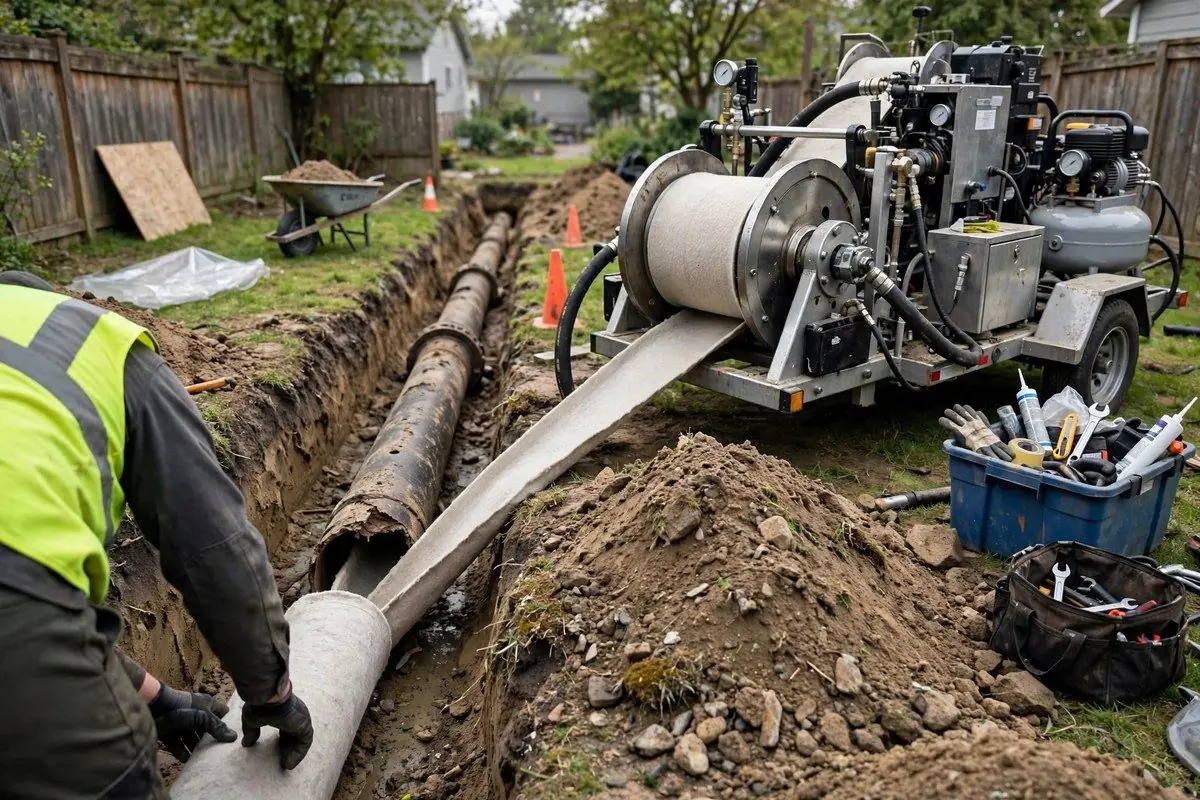
If sewage is backing up into a tub, a floor drain or a basement, the 24/7 line is open for sewer line repair in Plainsboro. Stop all water use, keep the washer off, and keep people and pets away from the affected area. Cleaning the line may restore flow for the night, but a repeat backup means the pipe itself has failed.
A sewer lateral is the pipe that carries waste from your house to the public main. Roots, shifting soil, age and old joints can crack it, offset it or let it collapse. This page covers how a plumber confirms the damage, what the repair options really cost you in disruption and trade-offs, and how to dig safely.
Sewer backup: what to do first
Sewage is a health hazard, so protect the people in the house before you protect the floor.
Stop all water use
No flushing, showers, laundry or dishwasher. Everything you run goes into a pipe that is already full.
Keep people and pets away
Raw sewage carries bacteria. Keep children and animals out of the wet area and wear gloves and boots if you must enter.
Do not run the washer
A washing machine pumps a large volume quickly and is the usual cause of a second wave of backup.
Turn off power to wet areas if needed
If water has reached outlets, appliances or a furnace, leave the area and shut off the breaker only if you can do so from a dry spot.
Call the 24/7 line
Report which drains backed up and whether neighbours in an attached building have the same problem. That helps separate a private lateral from a shared line.
Signs a sewer line is damaged, not just clogged
A clog clears and stays clear. A damaged pipe keeps returning to these patterns.
- Backups repeat within weeks of every cleaning, even a thorough one.
- A cable or camera stops at the same point and will not pass.
- A sunken or unusually green strip runs across the yard toward the street.
- Mice or rats appear near the foundation or cleanout, because a broken pipe offers them a path.
- Floor drains smell of sewage even when dry-trap seals are full.
- A camera shows cracks, a gap at a joint, or a flattened section.
- Several fixtures back up at once, especially the lowest in the house.
Repair options and their trade-offs
The right repair depends on what the camera shows and how the pipe runs under your property.
| Option | Works when | Trade-off |
|---|---|---|
| Spot repair (dig and replace a short section). | One broken joint or crack with the rest of the line sound. | Needs an excavation at that spot and does not help if other sections are failing. |
| Cured-in-place lining. | Pipe is structurally intact but cracked or root-prone. | A liner relies on the host pipe shape, so a collapsed or badly bellied pipe is unsuitable. |
| Pipe bursting. | The line is failing along its length and a new pipe can follow the old path. | Needs entry pits at each end and nearby utilities must be located and protected. |
| Full open-trench replacement. | The line is collapsed, bellied or runs through unstable ground. | Most disruptive to lawn, driveway and landscaping. |
| Cleaning only. | A temporary clog with no structural damage. | Roots and cracks return, so it is a delay, not a repair. |
Trenchless methods avoid digging up the whole yard, but they are not always possible and they still require access pits.
Cracks and roots
Roots do not break a healthy pipe. They find a hairline crack or a loose joint, grow in looking for moisture and nutrients, and thicken until they block the line and widen the crack. A cutting head or hydro jetting clears the mass, and a camera shows where the root entered. If that spot is a single joint, a short spot repair may stop the cycle. If roots enter at many joints, lining or replacement is the better long-term fix.
Cast iron is a separate problem in older buildings. It corrodes from the inside and can flake in layers, narrowing the pipe before it cracks. A camera can show scale and pitting, and a plumber can replace a cast iron section with modern pipe while leaving the sound part in place.
Septic is rare here
Most of Plainsboro is on public sewer, so septic tanks are uncommon. If you are unsure, check your closing papers or ask the township, because a septic backup needs a different fix than a city lateral. Do not assume a particular street has septic without checking.
Old village homes, newer stock, and who answers which question
Plainsboro Village, the old settled core, is mapped for single-family homes on larger lots, and some of its buildings date back to the 1700s. By contrast, Walker-Gordon homes were approved in 1988. Pipe age and material differ across those eras, so the camera look matters more than the house age. Ask the plumber to record the pipe material during a sewer camera inspection and show you the footage before agreeing to a repair.
For permits, the township Building Division on Plainsboro Road lists plumbing among its subcode sections. NJ treats replacing existing piping with approved material of like capacity as minor work, which still involves notice to the local enforcing agency before work starts. Ask the Building Division how it handles a sewer lateral on your property, and ask your plumber who files.
The sewer service split also matters. East of the railroad, the line feeds the Princeton Meadows plant. West of it, including Forrestal Center, it feeds the Stony Brook Regional Sewerage Authority. If the damage turns out to lie in the public main rather than your lateral, the utility for your side of the tracks is the one to ask.
Call 811 before anyone digs
New Jersey law requires notice to NJ One Call by dialing 811 at least three business days before excavation, and no more than ten. Utility crews mark gas, electric, water and communication lines with paint or flags. Within two feet of a marked line, crews dig by hand. Marks can wash away after heavy rain, so recheck them if the dig is delayed. A licensed plumber normally files the request for a repair, so ask who is responsible.
Before any trench is opened, call New Jersey One Call at 811 at least three business days ahead. The repair itself falls under New Jersey's plumbing subcode, the National Standard Plumbing Code.
What moves the cost of a sewer line repair
A real number needs a camera look and a depth reading, but these factors explain why two repairs on the same street can differ.
Length of damage
One cracked joint is a small repair. Failure along most of the line pushes toward lining, bursting or replacement.
Depth and route
A deep line, or one that runs under a driveway, patio or mature tree, adds excavation and restoration work.
Method
Trenchless methods cost more in equipment and less in landscaping, while open trench is the reverse.
Permits and inspection
Local requirements and an inspection step add time and fees that your plumber can explain.
Emergency timing
After-hours work to stop an active backup costs more than scheduled repair work.
Homeowners policies often exclude wear, tree root damage and the pipe itself. Some cover resulting water damage if a sewer-backup endorsement exists. Ask your insurer before work starts and keep the camera footage as documentation.
Call the 24/7 line for a camera look and a clear price before work starts.
Call (609) 547-1417Sewer Line Repair questions from Plainsboro homeowners
Yes. The 24/7 line sends a licensed plumber to stop an active sewage backup at any hour. Expect cleaning and a camera look first, with the repair scheduled once the damage is known.
If the backup returns within weeks of cleaning, or a camera shows cracks, offsets or a collapsed section, cleaning is only a delay. See sewer line cleaning for what cleaning can and cannot do.
No. It limits digging, but a liner needs a pipe that still holds its shape, and pipe bursting needs pits at each end. A collapsed or badly bellied line may require open-trench replacement.
If the backup is small and contained, many people stay, but keep children and pets out of the affected area and avoid water use. For large or deep sewage, leave the area and call for help.
Most of the township is on public sewer, so septic is uncommon. Check your closing papers or ask the township if you are unsure.
The utility that owns the main handles it, but proving it takes a camera look that shows a clear lateral. Ask the utility for your side of the railroad and keep your plumber's footage.
The Building Division on Plainsboro Road decides. NJ treats like-for-like piping replacement as minor work, which still needs notice first. Ask the Building Division and your plumber who files. Nearby West Windsor sets its own sewer-connection rules, so do not assume they match.
Backup keeps returning after cleaning?
The pipe may be cracked or offset. A camera look and a repair plan come after the immediate backup is under control.
Where we dispatch from
We send sewer line repair crews across Plainsboro and the neighboring towns. Our base is 777 Scudders Mill Rd, Plainsboro, NJ 08536, and the map shows the surrounding towns we serve.