Most people do not search for hydro jetting by name. They search because the drain clogged again, the plumber's snake stopped partway, or the same kitchen line has needed clearing every few weeks. If a line is backing up right now, our 24/7 dispatch in Plainsboro can bring a plumber with a camera and a jet, and until then stop running water into the house.
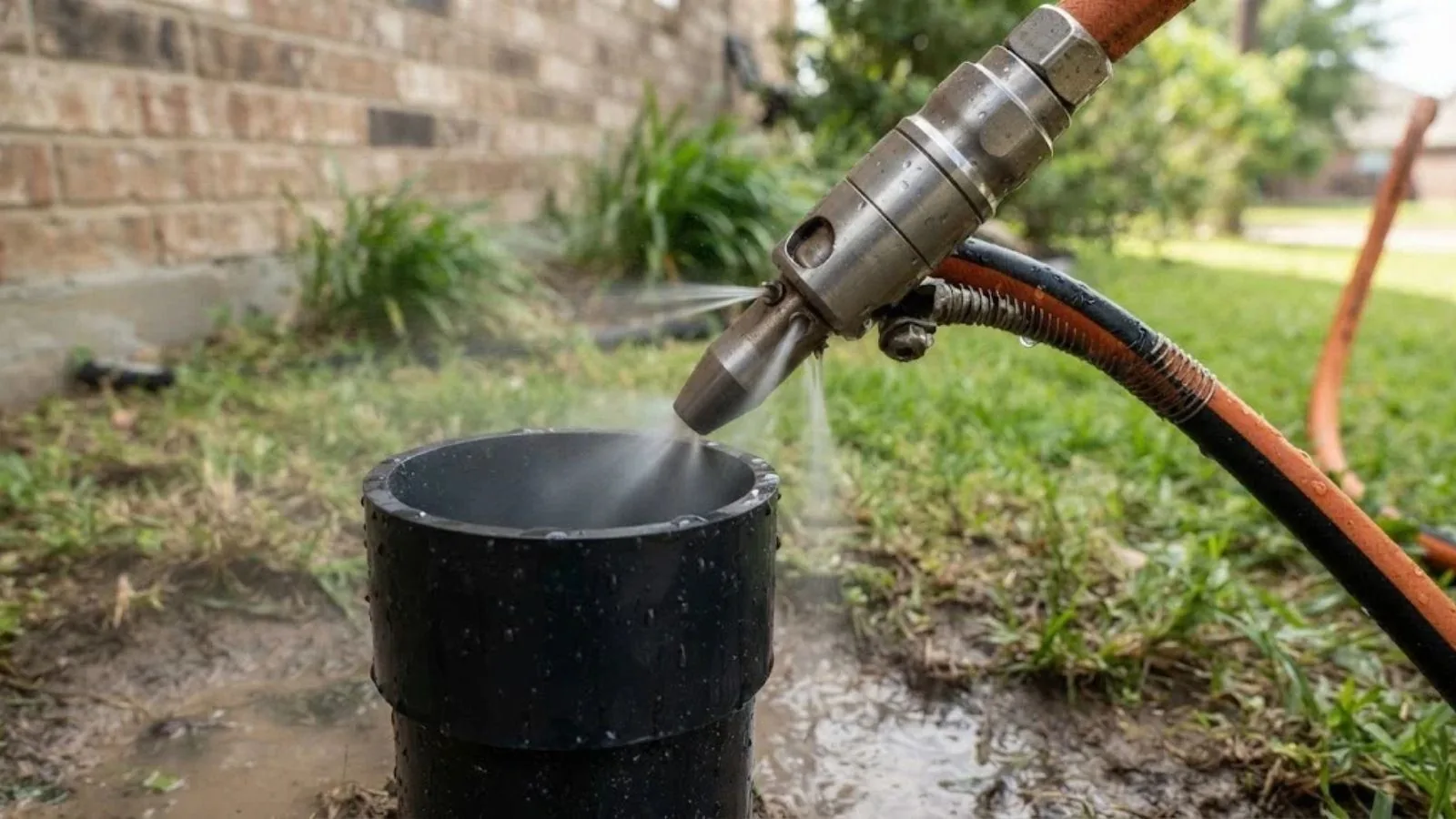
A hydro-jet sends water at high pressure through a hose and a shaped nozzle, scouring grease, scale and silt off the pipe wall instead of poking a hole through it. That is a different job from cabling, and it is not right for every pipe. This page explains what jetting does, which nozzle does what, and the cases where a careful plumber will refuse to jet at all.
Why the snake stopped partway, and why the clog returns
A cable is a spinning wire. It pushes through a blockage and pulls some of it out, but it leaves a ring of buildup on the pipe wall. If the line was already narrowed by grease or mineral scale, the new opening is only as wide as the cable head. Water flows again, then slows as new debris catches on the old coating.
When the cable stops partway, one of three things is happening. The blockage may be a dense root mass, the pipe may have an offset joint or a belly where water pools, or the cable has turned a corner it cannot pass. A drain camera tells these apart. Jetting only makes sense once you know which one you have.
Nozzle types in plain terms
A jet hose is only as useful as the nozzle on its end, and plumbers swap them during a single job.
| Nozzle | What it does | Typical use |
|---|---|---|
| Penetrator or bullet. | Fires a tight forward stream to break a hard plug. | Opening a fully blocked line so water can flow. |
| Rear-facing spray. | Sends jets backward to pull the hose forward and scour the wall. | Clearing grease and scale along the pipe. |
| Rotating or spinning head. | Spins jets around the pipe to cut a full circle. | Heavier scale, silt and soft roots. |
| Chain or cutting head. | Adds chains or blades to the spin for root cutting. | Root intrusion, followed by a camera check. |
| Flat or sled nozzle. | Rides low in the pipe to avoid snagging at joints. | Fragile or older pipe where gentler cleaning is wiser. |
Pressure settings change by pipe size and material, which is why the camera look comes first.
Symptoms that point toward jetting rather than another cabling
Any of these patterns suggests buildup on the pipe wall, not a single plug.
- The same drain slows down again within weeks of being cleared.
- The cable returns with a greasy, gray or sandy residue on it.
- The cable stops at the same distance every time.
- Roots show up on the cable or in the cleanout, and the line has needed cutting before.
- A food-service kitchen drain needs service on a schedule to stay open.
- Several fixtures drain slowly rather than just one.
- A camera shows a narrowed pipe with rough coating on the walls.
When not to jet
Jetting is not safe on every pipe. If a camera shows a collapsed section, a large crack, a separated joint or a pipe that has lost its wall to corrosion, high-pressure water can widen the damage or push debris through the break into the soil. Those lines need repair first, and sewer line repair is the next conversation. A plumber who offers to jet a pipe without looking at it first is guessing.
Right now: a backed-up line that will not clear
If the water is rising or sewage is visible, a few actions limit the damage until a plumber arrives.
Stop using water
Pause the washer, dishwasher, showers and toilets. Every flush adds to what is already stuck.
Note what is affected
Which fixtures are slow, which are gurgling, and where the water appears. That helps the dispatcher choose a cable, a jet or a camera.
Clear access
Move boxes and furniture away from the cleanout and the lowest drain so the plumber can reach the line quickly.
Do not run chemicals
Drain cleaner mixed with standing sewage splashes badly and can ruin a pump or hose that later touches it.
Call the 24/7 line
Mention whether a cable has already been used and how far it went. That detail tells the plumber whether to start with a jet or a camera.
Grease in kitchen and restaurant lines
Grease is the main reason food-service lines need jetting. It cools in the pipe and hardens, and each warm wash melts a bit more and lets it settle a little farther down. A cable passes through the middle and leaves the coat intact. A rotating jet head with hot water cuts it back to bare pipe.
Jetting is a cleaning schedule, not a cure. If the kitchen has no grease interceptor, or the interceptor is full, the grease will come back no matter how well the line was jetted. Ask the property manager when the trap was last pumped.
Scale, silt and roots
Scale is mineral crust that grows inside older pipe and narrows it like plaque in an artery. Silt is fine grit that settles where a pipe sags. Roots enter at joints and send hair-like fibers into the flow. A cutting nozzle clears roots, but the joint stays open, so they return unless the joint is sealed or lined. For the camera side of that diagnosis, see sewer inspection.
Plainsboro buildings and the lines jets are asked to clear
Township planning documents describe the 1970s and early 1980s as a period dominated by multifamily construction. In condo and townhouse buildings of that era, kitchens and baths on different floors often tie into one shared stack. A clog low in the stack backs up into the lowest unit. Jetting that stack affects every neighbour, so the association or property manager should approve it.
Plainsboro Village Center, on Schalks Crossing Road, mixes about 110,000 square feet of commercial space with townhouses, homes and rental apartments above retail. In a mixed-use building the grease from a shop kitchen and the hair from an apartment above can share one drain. If a commercial tenant cooks, ask the landlord about the grease trap and who maintains it before the next jetting visit.
The sewer system also splits at the railroad. East of the tracks it feeds the Princeton Meadows plant, and west of them, including Forrestal Center, it feeds the Stony Brook Regional Sewerage Authority. Jetting clears your own lateral, but if the debris keeps returning at a street cleanout, ask the utility for your side whether the public main needs attention.
Jetting is a cleaning method, not a code item, but any pipe repair that follows it falls under New Jersey's plumbing subcode, the National Standard Plumbing Code, and a camera recording is the best way to document what the jet found.
What affects the price of hydro jetting
A plumber prices a jet visit after seeing the line, because pipe size and condition drive the work.
Camera look first
A camera pass before jetting adds time but prevents damage to a fragile pipe, so many plumbers treat it as part of the job.
Length and diameter
A short 3 inch line is quick. A long run or a 6 inch building drain needs more hose and water.
Access
An outdoor cleanout is simple. Working through a roof vent or a pulled toilet takes longer.
What is in the pipe
Light grease is one pass. Heavy scale or roots may need several nozzle changes.
Timing
After-hours dispatch costs more than a scheduled daytime slot. Ask before work begins.
Homeowners policies usually do not pay to clear a recurring clog, and sewer backup coverage is often a separate endorsement. If a backup has damaged finished space, ask your insurer what proof it wants before cleanup.
Call the 24/7 line to describe the clog and its history so you can get a clear price before work starts.
Call (609) 547-1417Hydro Jetting questions from Plainsboro homeowners
Yes. The 24/7 line sends a licensed plumber for backed-up lines at any hour, and a camera look normally comes before the jet. Stop running water and tell dispatch whether a cable has already been tried. The same dispatch reaches South Brunswick next door.
It is better for buildup on the pipe wall, such as grease, scale and silt, because it washes the pipe clean instead of boring a hole through the clog. A cable is still the right tool for a simple plug in a fixture line. See drain cleaning for when that is enough.
On sound pipe, a correctly set jet is safe. On a cracked, collapsed or heavily corroded line it can widen the damage. That is why a camera look comes first and why fragile pipe gets a gentler nozzle or a repair.
It depends on volume and whether a grease interceptor is working. A line that clogs monthly is a candidate for a scheduled cleaning, but a full or missing trap needs attention first.
No. A cutting nozzle clears the roots in the pipe, but they return through the same joint. A sealed joint, a spot repair or a liner stops the cycle. See sewer line cleaning for the cleaning side.
Only after asking your association. A shared stack serves several units, so a jet pass changes conditions for neighbours below you and the management usually approves the work.
Jetting cleans your own lateral, so it works the same on either side. The split matters if the blockage is in the public main, where the utility for your side of the tracks is the one to contact.
Cable only bought you a few weeks?
A camera and a jet can find and clear what the snake missed, and the 24/7 line is open when it backs up.
Where we dispatch from
We send hydro jetting crews across Plainsboro and the neighboring towns. Our base is 777 Scudders Mill Rd, Plainsboro, NJ 08536, and the map shows the surrounding towns we serve.