
The meter dial keeps creeping with every tap shut. The water bill is double last month's. One patch of floor feels warm, or a ceiling stain is slowly widening. Most people notice these signs long before they use the word leak. For emergency leak detection in Plainsboro, NJ, the 24/7 line is open at any hour, and while you wait, close the main shutoff if water is visibly spreading.
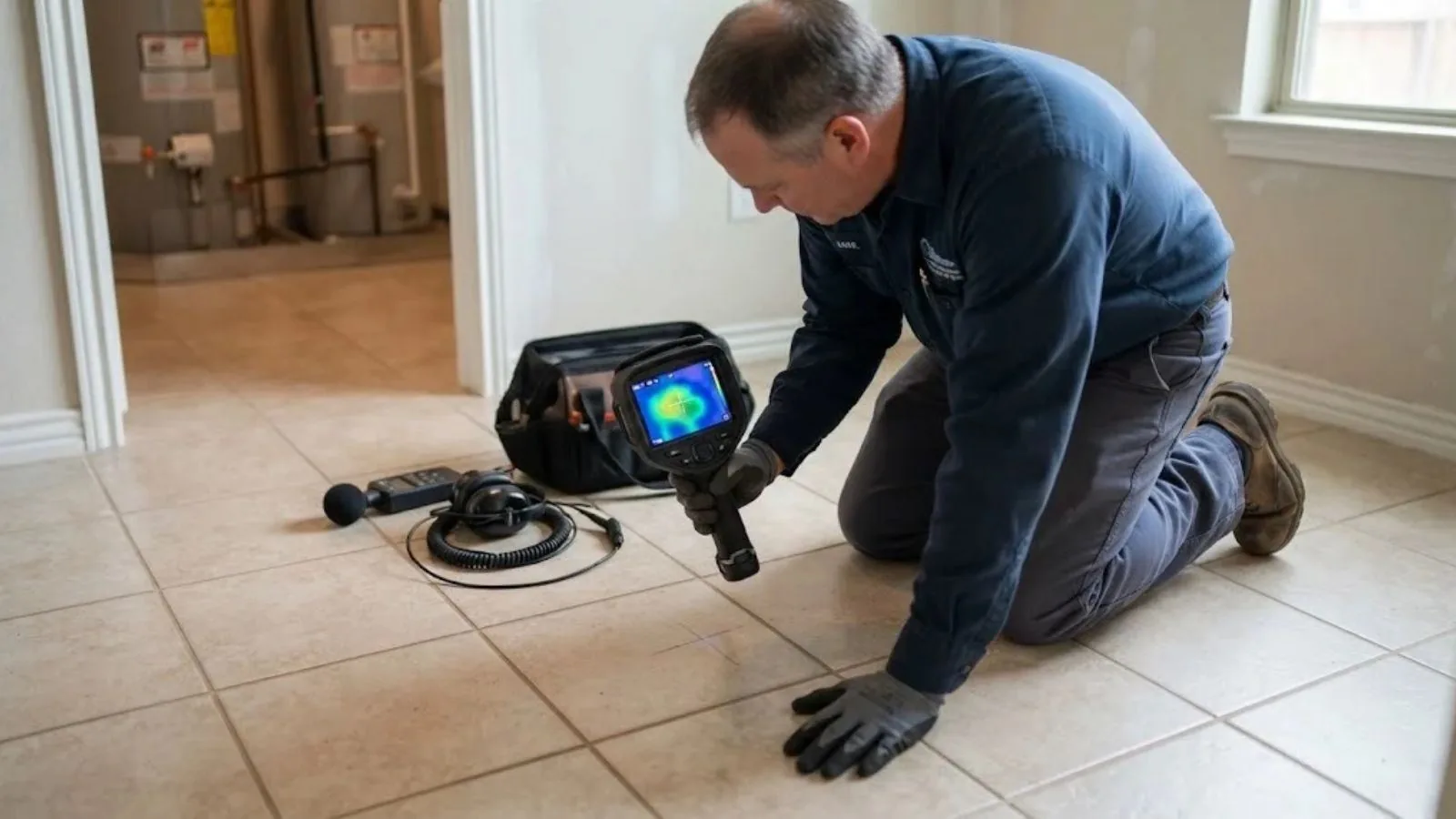
Hidden water is hard because the wet spot is rarely where the pipe is broken. Water runs along joists, pipes and slab edges before it shows itself. Finding the true source takes listening gear, a thermal camera and pressure checks, not guesswork. That matters because every wall opened in the wrong place is a repair you pay for twice.
When a hidden leak becomes an emergency
Treat it as urgent when water is actively coming through a ceiling, when a wall is soft or bulging, or when you can hear running water and cannot find a fixture using it. Water near a panel, outlets or a light fixture is urgent too. Shut the main valve (a pipe that has split outright is covered under burst pipe repair). Switch off power to that area only if you can reach the breaker dry.
A slow leak that only shows on the meter is different. It can usually wait for a same-day appointment when available, as long as you keep the main closed overnight if you are away. Water that stays in contact with framing and insulation for days leads to mold and rot, so do not let a slow leak sit for weeks.
The meter test: is water moving with everything off?
Your water meter can confirm a leak before anyone opens a wall. Turn off every fixture, the ice maker, the irrigation controller and any running appliances. Then look at the meter register. Most residential meters have a small leak indicator, often a triangle or star, that turns whenever even a trickle passes through. If it keeps moving with everything off, water is escaping somewhere.
For a second check, write down the register reading, leave every tap closed for about half an hour, and read it again. A change means a leak. Your water comes from New Jersey American Water, so call its customer line, which the township lists on its Contact Us page, to ask about the meter and any unusual usage on the account.
What to do and what to note before the plumber arrives
A short list of observations saves search time and narrows where to listen first.
- Meter indicator moving with all fixtures off, and the register reading with the time you checked it.
- The date the water bill first jumped, and whether usage rose steadily or in one step.
- Any room where the floor feels warm, cool or soft underfoot, or where carpet feels damp.
- Stains on ceilings or walls, with a pencil outline and date so you can see if they grow.
- The sound of running or hissing water at night when the house is quiet.
- Low pressure at one fixture or the whole house, and whether it changed suddenly.
- Where the main shutoff is, and whether it turns freely.
Ceilings, walls and attics
A brown ring on a ceiling usually means water has traveled from a supply line, a drain, a roof leak or a condensation problem above. Plumbers separate these by checking whether the stain grows only when someone showers, runs a dishwasher or when it rains. A stain that grows only in wet weather is a roof or flashing issue, not a plumbing one.
In walls, a moisture meter and thermal camera map the damp area without a single hole. Hot supply lines show up as warm stripes, and a cold wet patch shows evaporation. If the damp area sits below a bathroom, a shower valve or a tub drain is the usual suspect. Attic leaks often come from a failed connection on a supply line or a condensate line from an air handler.
Under floors, in crawlspaces and in basements
Leaks beneath a floor show up as a warm spot over a hot supply line, a musty smell, buckled boards or a floor that stays cool in winter. If the home has a crawlspace or basement, a look at the joists and pipe runs often finds drips, stained insulation or mineral trails on copper joints within minutes.
Where the pipes run inside the slab or behind finished surfaces, acoustic listening and tracer gas do the work. Water that appears in a lower level after heavy rain is another story. That is often ground-water seepage, not a pipe, and the fix is outside the plumbing system, as described under basement waterproofing.
Buried lines, irrigation, pools and meter boxes
Buried supply line. A leak between the street and the house shows as a wet patch in the yard, a sunken stripe of lawn, or pressure that fades slowly. Line locating gear traces the pipe and a listening microphone finds the hissing point. If the break is on the service pipe itself, the next step is covered under water service line repair.
Irrigation. A zone valve that sticks open, a cracked head or a split lateral wastes water only when the system runs, so the meter may spin only at certain times. Shutting the irrigation supply and retesting the meter isolates it.
Pool and spa lines. Plumbing for a pool fill line, heater loop or spa can leak under a deck or patio. Pressure-testing each line by itself separates it from the house supply.
Yard and meter-box leaks. Water pooling around the meter box can come from a failed fitting at the meter or from the curb stop. Those are often the utility's responsibility, so call New Jersey American Water before digging.
Detection methods and what each one finds
Plumbers combine tools because no single method finds every kind of leak.
| Method | What it finds | Limit to know |
|---|---|---|
| Acoustic listening. | Hiss or drip sound on pressurized pipe, through floors, walls or soil. | Plastic pipe carries sound poorly, background noise can mask it. |
| Tracer gas. | Tiny leaks in slab or buried lines, gas rises to the surface. | Needs a drained, isolated line and open ground to sample. |
| Thermal imaging. | Hot lines, cold wet patches, radiant floor problems. | Shows temperature differences only, not the leak itself. |
| Pressure testing. | Whether a line, zone or whole house holds pressure. | Tells you a leak exists, not exactly where. |
| Line locating. | Path and depth of buried pipe before any digging. | Needs a metal pipe or a tracer wire to trace. |
| Moisture meter. | How far dampness spreads in drywall, wood or subfloor. | Reading can be fooled by metal or condensation. |
Access holes are kept small and placed after the readings agree, so patching is usually a drywall fix, not a rebuild.
How a detection visit unfolds
The order is from least invasive to most, and each step narrows the search.
Review the clues
The plumber checks the meter indicator, your notes and the history of the water bill.
Isolate the system
Fixtures, zones and the irrigation, pool and appliance lines are shut off one at a time while the meter is watched.
Listen and image
Microphones, a thermal camera and a moisture meter map the likely area.
Confirm the spot
A pressure test or tracer gas verifies the source before any cutting.
Open small, repair and patch
A compact access hole is cut, the pipe is fixed or replaced, and the opening is closed for drywall finishing.
Plainsboro homes, two eras and a high water table
Plainsboro's own Land Use Plan says the 1970s and early 1980s were dominated by multifamily construction, and later single-family homes took over. Older stock may have original copper or galvanized pipe, while the Walker-Gordon neighborhood (zoning approved in 1988) has newer piping. Ask the plumber what material the leak is on, because age often tells you whether one failure is a warning of more.
The same plan notes seasonal high water tables, which is why spring water in a lower level may be ground water instead of a leak.
Run the meter test first. If the meter is still when everything is off, the water is probably coming from the soil, not the supply. In Plainsboro Village, where some buildings date from the 18th century, older lines and mixed materials make careful tracing even more worthwhile. Water from the Raritan system comes through New Jersey American Water, so a questionable bill or meter reading goes to them. The same leak checks apply across the line in South Brunswick.
New Jersey requires plumbing contractors to be licensed through the State Board of Examiners of Master Plumbers, so verify the license before anyone opens a wall, and expect the repair to meet the National Standard Plumbing Code, the state's plumbing subcode.
What affects the price of finding a leak
Detection is billed on time, equipment and access, and the plumber explains the plan before work starts.
Where the leak is
A visible fixture leak takes less time than one behind tile or under a slab.
Number of methods needed
If listening and imaging agree, the visit is short. Disagreement means more testing.
Access and repair
A small hole in drywall is simple. Concrete, tile or landscaping costs more to open and restore.
Time of day
After-hours and weekend dispatch can carry a premium over a regular same-day appointment.
Pipe material and depth
Plastic and deep lines are harder to hear and locate than shallow copper.
Homeowners policies vary. Many cover sudden water damage but not the cost of finding or fixing the pipe that failed, and some exclude long-term seepage. Ask your insurer before any walls are opened, take photos, and keep the plumber's written findings for the claim.
Call the 24/7 line for a clear price before work starts, based on what you describe.
Call (609) 547-1417Leak Detection questions from Plainsboro homeowners
Yes. The 24/7 line takes calls at any hour, and a licensed plumber can be dispatched for active leaks. Slow meter-only leaks are usually booked as a same-day appointment when available.
Close your main shutoff and watch the meter. If it keeps turning, the leak is on the utility side of the valve, so call New Jersey American Water. If it stops, the leak is inside your system.
Not until the source is confirmed. Listening, imaging and pressure tests find the spot first, then a small access hole is opened only there.
Yes. A running toilet, a dripping line under a slab or a buried leak can waste water for weeks with nothing showing.
It can be. Plainsboro's Land Use Plan notes seasonal high water tables, and water that appears after rain with the meter still is often seepage. A sump pump check may be the next step.
Coverage varies by policy. Some pay for resulting damage but not for finding the leak, so ask the insurer before walls are opened.
It depends on where the break is. Ask New Jersey American Water to confirm the ownership boundary before paying for excavation.
Find the leak before the wall comes open
Call the 24/7 line and describe the meter, the stain or the sound, and a plumber will plan the search.
Where we dispatch from
We send leak detection crews across Plainsboro and the neighboring towns. Our base is 777 Scudders Mill Rd, Plainsboro, NJ 08536, and the map shows the surrounding towns we serve.