
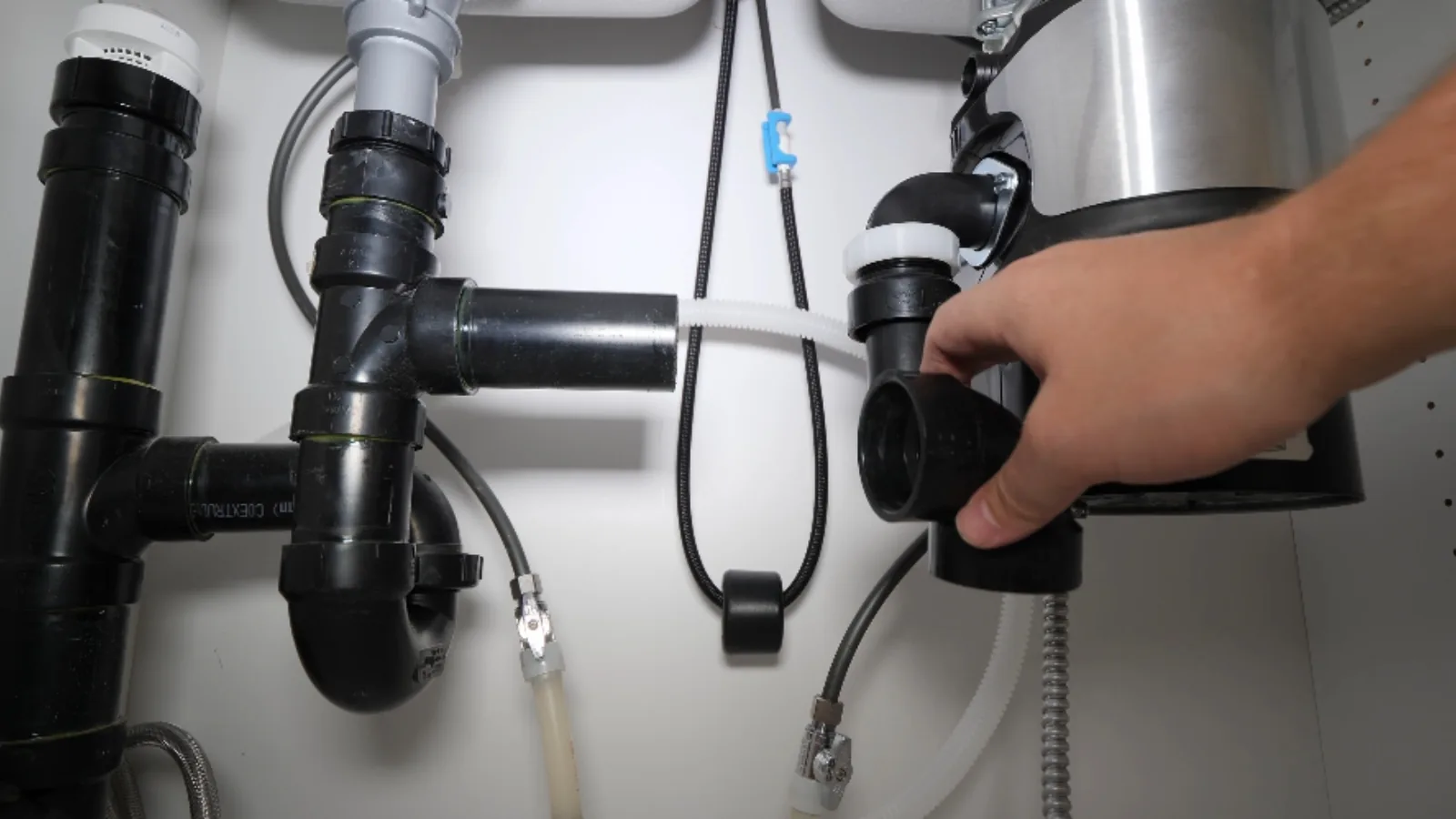
A humming disposal that will not spin is usually jammed. A silent one has usually tripped its reset button or lost power. A leak means a failed seal, a loose connection, or a cracked housing. Before touching anything, switch off the wall switch and the breaker, or unplug it, and never put a hand inside. Many jams clear with a hex key from underneath. Leaks from the body, or a disposal that keeps jamming or tripping, usually call for replacement. Talk to dispatch if the problem is happening now.
Safety steps before you touch a disposal
A disposal cannot be treated like a faucet. Do these in order every time.
Cut the power
Turn off the wall switch, then turn off the breaker or unplug the unit under the sink. A switch alone is not enough.
Never use your hand
Do not reach into the grinding chamber. Use tongs or pliers to remove anything you can see, with a flashlight.
Look for the hex socket
Many disposals have a hex socket in the center of the bottom. A hex key turned back and forth frees a jammed flywheel.
Press the reset button
Wait a few minutes for the motor to cool, then press the red reset button on the bottom of the unit.
Test with water running
Restore power, run cold water, and switch the unit on. If it hums again, stop and call a plumber.
Symptom, cause, fix and whether to repair or replace
Most disposal problems fall into a few patterns.
| Symptom | Likely cause and fix | Repair or replace |
|---|---|---|
| Hums but does not spin. | Jammed flywheel. Free with the hex key, remove the obstruction, then reset. | Repair, unless it jams again soon. |
| Silent, no hum. | Tripped reset or dead outlet. Press reset and check the breaker and switch. | Repair first. Replace if it trips repeatedly. |
| Leaks at the top flange. | Worn flange seal or loose mounting ring. Tighten or reseal the sink flange. | Repair |
| Leaks at the dishwasher or discharge pipe. | Loose clamp or worn gasket. Tighten or replace the gasket. | Repair |
| Leaks from the body or seam. | Cracked housing or failed internal seal. Not repairable. | Replace |
| Slow drain with grinding smell. | Residue buildup or partly blocked drain line past the disposal. | Clean, then check the line. |
A disposal that is more than a few years old and leaks from the body is usually past repair.
Why a disposal hums and then stops
A hum without motion means the motor is trying to turn a stuck flywheel. The most common culprits are a bone, a fruit pit, a bottle cap, or a lid that fell in. Hard items wedge between the grinding ring and the impellers.
After freeing the jam, run cold water for a minute with the unit on to flush loose debris down the line. If the motor still hums, the motor winding or a bearing may be worn.
Dishwasher connection: the knockout plug and the hose
The dishwasher drain hose connects to a small nipple on the side of the disposal. A new disposal ships with a plastic knockout plug inside that nipple. If it is not removed, the dishwasher drains poorly and water backs into the dishwasher.
The hose should also loop up high under the countertop before it reaches the disposal, which helps keep sink water from running back. A kinked or sagging hose can leave the dishwasher full of dirty water.
If the sink backs up only when the dishwasher drains, check this connection first. A garbage disposal repair visit can often fix it in one trip.
Odors and slow drains after the disposal
A smell that returns a day after cleaning usually comes from film on the grinding chamber, the rubber splash guard, or the drain pipe just past the unit. Scrub the splash guard with a brush and dish soap, then run cold water and a handful of ice cubes through the unit to knock off loose film.
If the sink drains slowly even with a clean disposal, the restriction is in the pipe beyond it. That is the time for drain cleaning with a proper machine, since a disposal's own motor can only push scraps along, not scour a coated pipe.
Gurgling in other fixtures when the disposal runs points past the kitchen, to the branch or main line.
When replacing makes more sense than repairing
Replacement beats repair when the housing leaks, the motor hums and jams again after clearing, or the unit trips its reset every few uses. Repairing an old unit that fails at the body seam rarely lasts. Ask the plumber what failed and whether the part is sold separately, so the decision rests on facts instead of a hunch.
Match the new unit to the sink: check the mounting style, the dishwasher inlet, and the horsepower. A larger motor does not fix poor habits, and a unit that fits the old sink flange saves a rebuild. Turn the old unit off at the breaker for good if you will be away from the house during the swap.
Where your disposal drains in Plainsboro, NJ
A disposal discharges into the same house drain as your other fixtures. In Plainsboro that drain leads to one of two systems, split by the rail line: the Princeton Meadows plant east of the railroad, or the Stony Brook Regional Sewerage Authority west of it. Ask your sewer provider what it recommends for grease and food waste.
Grease is the worst offender. It cools in the pipes beyond the disposal and builds up as a coating that can later trap wipes and roots. A disposal grinds food, but it does not make grease safe to pour down the line.
Replacing a disposal in the same spot counts under N.J.A.C. 5:23-2.17A as installing a fixture in existing space, which is minor work with notice to the local enforcing agency. The township Building Division on Plainsboro Road also lists Electrical, so ask whether new wiring changes the paperwork.
Disposals are sold as UL listed products, which means they were tested to a safety standard. Check for the listing mark on a replacement, and have the connection inspected if the cord or cabinet wiring looks worn.
Where this comes from: township Utility Service Plan (master plan chapter), N.J.A.C. 5:23-2.17A text and township Building Division permit page.
What should never go into a disposal
These cause jams, odors, and downstream clogs.
- Cooking grease, oil, and fat, which coat the pipes beyond the disposal.
- Coffee grounds in large amounts, which pack into a dense sludge.
- Fibrous scraps such as celery strings, corn husks, and artichoke leaves.
- Bones, fruit pits, and shells, which jam the flywheel.
- Flushable wipes, paper towels, and cleaning rags dropped in by mistake.
- Harsh chemical drain openers, which can corrode seals and splash.
Questions readers ask
It is almost always jammed. Switch off the power, free the flywheel with a hex key from underneath, remove the obstruction, then press reset.
If the leak is at the flange or a hose connection, yes. If it leaks from the body or seam, replacement is the safer choice.
That depends on the tank and local rules. Ask the township or a plumber before installing one.
The disposal knockout plug may still be in place, or the drain hose may sag or kink. Both are easy to check from the cabinet below.
Food and grease go down the same house drain as everything else. Ask your sewer provider, east or west of the railroad, what it advises for grease and food waste. Nearby, Cranbury and West Windsor have their own arrangements, so the answer can differ.
A humming disposal is usually jammed, a silent one is usually tripped, and a wet cabinet usually means a seal or a cracked housing.
Call (609) 547-1417Where we dispatch from
Our plumbers work across Plainsboro and the neighboring towns on the map. Our base is 777 Scudders Mill Rd, Plainsboro, NJ 08536, and the map shows the surrounding towns we serve.