
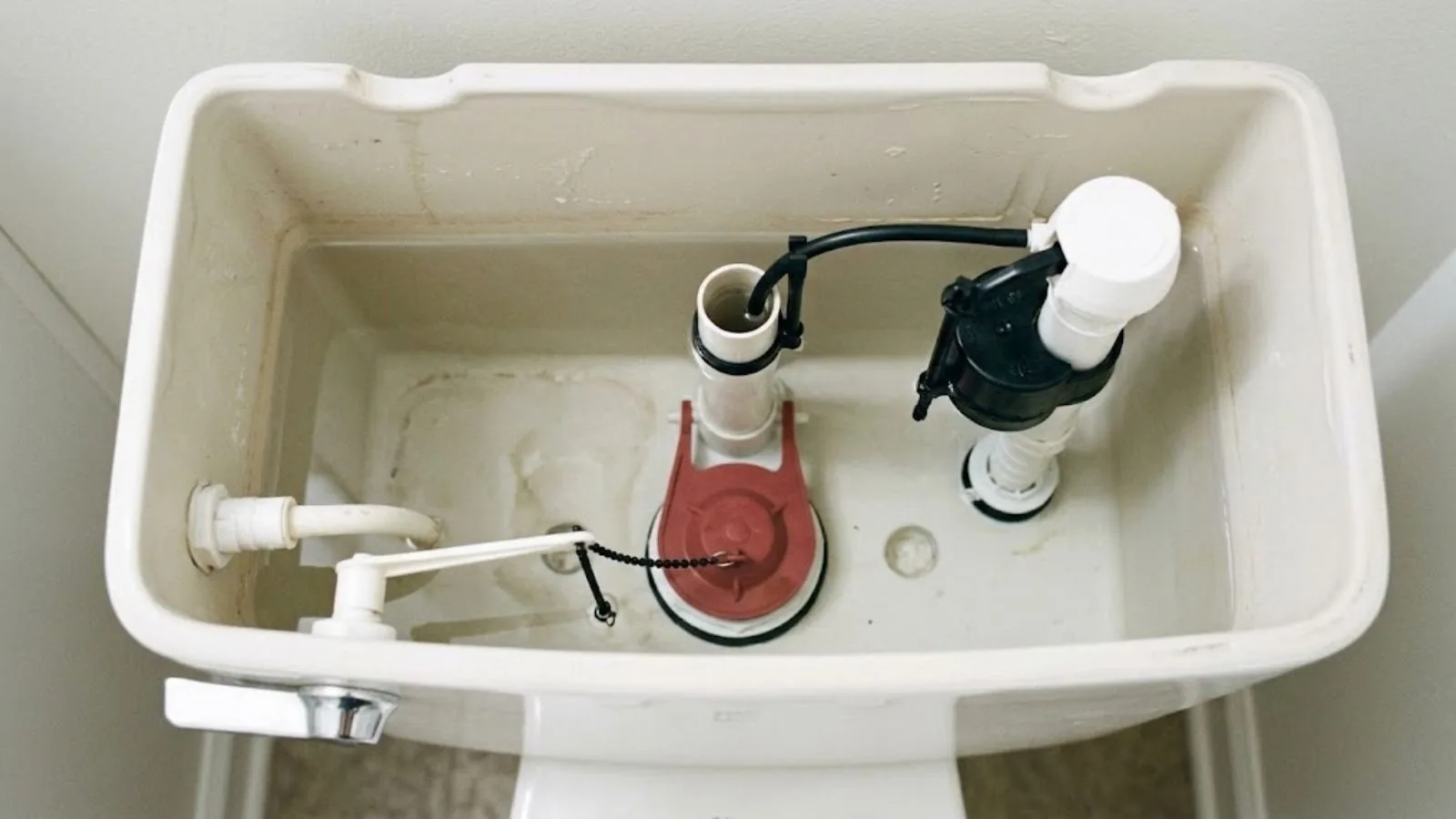
A leaking toilet usually tells you its cause by where the water appears. Water at the base points to a failed wax ring, loose closet bolts or a bad flange. Drips under the tank mean worn tank bolts. Water at the wall points to the supply line or shutoff valve. Sweating on a cold tank is condensation, and a dry paper test separates it from a leak. If water is flowing now, close the shutoff valve first. Talk to dispatch if the problem is happening now.
What to do if the toilet is leaking right now
Stop the water first and diagnose afterward.
Close the toilet shutoff valve
Turn the oval handle at the wall clockwise until it stops. Flush once to empty the tank and confirm the water has stopped.
If the valve will not close, shut the main
Close the main shutoff where water enters the house. Old valves can stick or drip at the stem, so do not force them with a wrench.
Soak up the water
Use towels, then a wet vac if you have one. Standing water on a floor can reach the ceiling below, especially in condos and second-floor bathrooms.
Keep the toilet off limits
Tape a note on the lid. A base leak can be sewage-contaminated, so wear gloves and wash up afterward.
Look for the source or call
If you cannot identify the source in a few minutes, or the floor is already soft, call a licensed plumber.
Where the water appears, the cause and the fix
Match the location of the water to the most likely part.
| Where water appears | Likely cause | Typical fix |
|---|---|---|
| Around the base of the bowl. | Failed wax ring, loose bolts or cracked flange. | Reseat the toilet on a new seal, repair the flange. |
| Under the tank, dripping from the bolts. | Worn tank-to-bowl bolts or gasket. | Replace the bolts and rubber washers. |
| At the wall below the supply line. | Loose nut or cracked supply line. | Tighten the nut or replace the braided line. |
| At the shutoff valve stem. | Worn packing or valve. | Snug the packing nut or replace the valve. |
| Hairline crack, slow weep. | Cracked bowl or tank. | Replace the toilet, since repair is not reliable. |
| Wet tank exterior, no drip source. | Condensation on cold china. | Run a fan, add a tank liner or anti-sweat valve. |
The base is the most common leak and the one most likely to damage the floor.
Leaks at the base: seal, bolts or flange
A toilet sits on a wax or wax-free ring pressed between the bowl and the flange. When the ring fails, or the toilet rocks and breaks the seal, water leaks out at the base when you flush. Often there is a slow ooze that shows only as a damp spot or a stained floor.
Check for rocking first. Grip the bowl and try to move it side to side. If it moves, the closet bolts are loose or the floor has softened. Tighten the nuts a quarter turn at a time, alternating sides, because over-tightening cracks the china.
If tightening does not work, the toilet has to come up, the old seal be scraped off and a new one set. The flange needs inspection too. A flange that is rusted, cracked or below the floor level will not hold a seal, and repairs go beyond a fresh ring.
Leaks at the tank, supply line and valve
Two or three bolts run from the tank through the bowl, each with a rubber washer. When those washers age, water drips from the underside of the tank onto the bowl rim or floor. Replacing the bolts and washers is a small job, and it tends to fix drips that look like base leaks.
A braided supply line can leak at either nut, or at a kink. Dry the line with a paper towel, then run a fresh tissue along it to see where the wet shows up. Tighten gently, as these fittings use rubber washers rather than thread tape.
The shutoff valve is the one to take seriously. A valve that weeps at the handle, or will not close fully, is a plumbing repair rather than a toilet repair, and it can be replaced during a toilet repair visit.
Is it a leak or condensation?
Run these checks before replacing any parts.
- Dry the tank, bowl and floor completely with towels.
- Lay dry toilet paper around the base and under the tank bolts.
- Add food coloring to the tank and see if color shows outside the bowl.
- Check the wet paper after an hour with no flushing.
- Compare against humidity: sweating is worst on summer days.
- Look at whether the water is clear and cold, which suggests condensation.
- Feel for warm or smelly water, which suggests the drain side.
- Wrap a dry paper towel around the supply line and check it later.
When floor damage is likely
A base leak that has run for weeks often leaves a soft subfloor, a stained ceiling below, or tiles that lift. Press the floor near the bowl with a screwdriver tip. If it sinks, the wood is rotted and a new seal alone will not hold.
At that point the repair involves lifting the toilet, cutting out rotted subfloor and rebuilding, which sits with leak detection and repair work more than a simple fixture job. Mold may follow, so keep the area dry and ventilated.
Water emergencies and who to call, Plainsboro, NJ
If your toilet supply valve fails and you cannot close it, the next step is the home main. If the main fails, the township Contact Us page lists NJ American Water's emergency and general inquiries line for Plainsboro, and the utility can advise on the street-side shutoff.
Plainsboro has a lot of condos and townhouses, and the township Land Use Plan says multifamily construction dominated the 1970s and early 1980s. In a shared building a base leak can drip into the unit below, so tell your association or landlord promptly and photograph the damage.
Plumbing work in New Jersey must be done by a master plumber, an authorized plumbing contractor, or their W-2 employees. You can check any plumber on the Division of Consumer Affairs License Verification System.
Where this comes from: township Contact Us page listing NJ American Water, township Land Use Plan and NJ Division of Consumer Affairs plumber licensing FAQ.
When to replace instead of repair
Cracks are a one-way street. A crack in the bowl or tank widens with use, and epoxy rarely lasts on a part that holds water and takes flush pressure. Replace the toilet.
If the toilet is old and has leaked several times, the economics change. A new seal, bolts and supply line are cheap parts, but repeated visits add up. Weigh that against the cost and effort of a fresh fixture.
The same rule holds for homes in South Brunswick and Cranbury. A seal that fails soon after a swap points to a flange problem, not bad luck. According to the EPA, WaterSense labeled toilets use 1.28 gallons per flush or less, compared with the federal maximum of 1.6, which is worth knowing if replacement beats repair.
Questions readers ask
Usually the wax ring has failed, the closet bolts are loose, or the flange is damaged. The toilet has to come up to fix it properly.
Not reliably. A crack in a bowl or tank keeps working under flush pressure, so replacement is the lasting fix.
Dry everything, lay dry toilet paper around the base and under the tank, and check later. Clear, cold water on the tank exterior is usually condensation.
Not for long. Water can soak the subfloor and drip into rooms below. Close the shutoff valve and call a plumber if you cannot find the cause.
NJ American Water. The township Contact Us page lists its emergency and general inquiries line for Plainsboro residents.
A base leak wastes little water but does floor damage. A running tank leak can use far more, which a meter test will show.
Where the water shows up tells you most of what you need to know.
Call (609) 547-1417Where we dispatch from
Our plumbers work across Plainsboro and the neighboring towns on the map. Our base is 777 Scudders Mill Rd, Plainsboro, NJ 08536, and the map shows the surrounding towns we serve.