
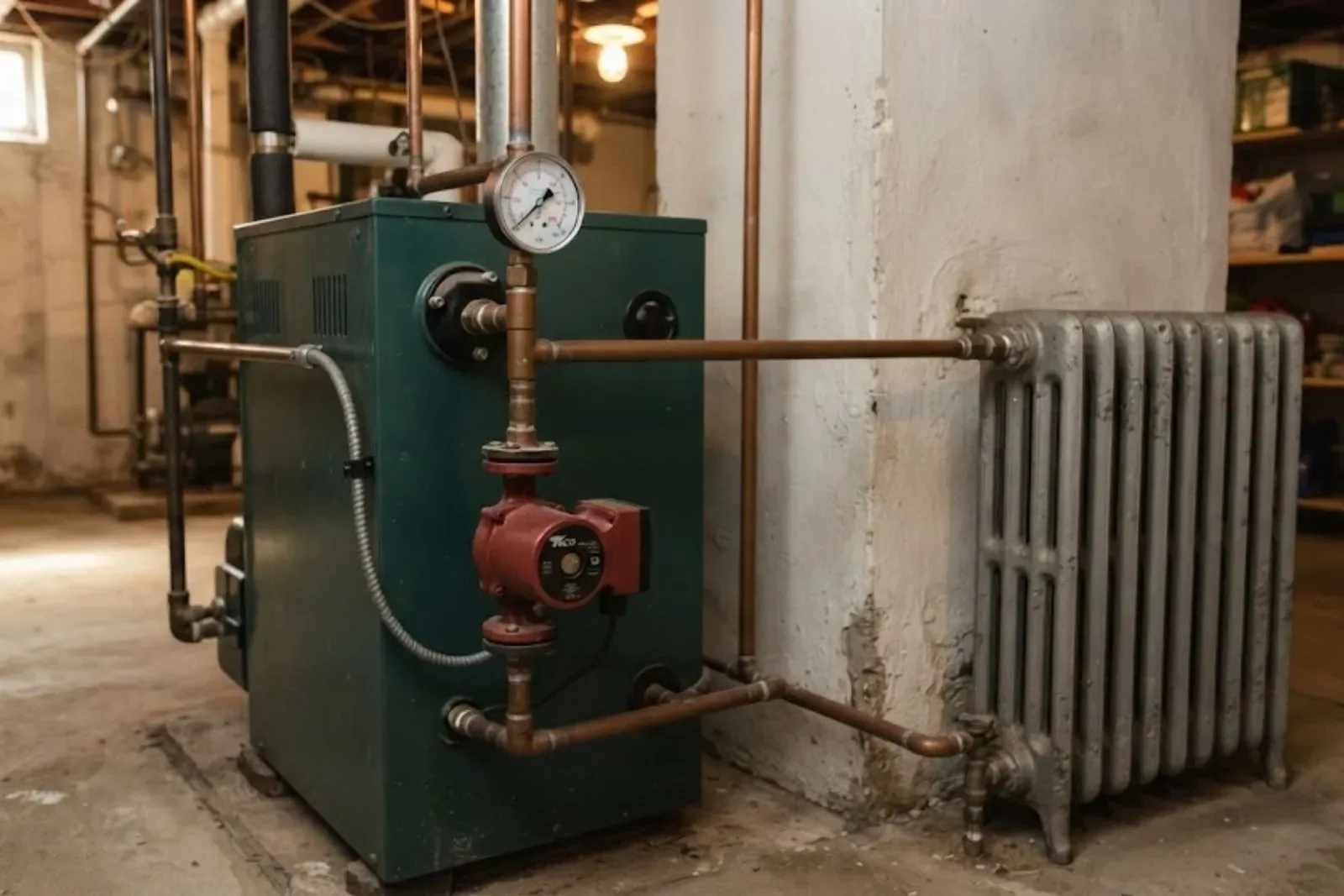
If the boiler has quit and the house is cold, call the 24/7 line now. While you wait for boiler repair in Plainsboro, check that the thermostat is calling for heat. Look at the pressure gauge, make sure the switch is on and the fuel valve is open, and let taps drip if pipes run along an outside wall. Do not keep resetting a boiler that locks out.
This page covers hot-water boilers and steam boilers and the baseboard, radiant or radiator piping they feed. It does not cover ducted furnaces or air conditioning, which are separate trades. The sections below sort symptoms by likely cause, say what is safe to try, and explain when carbon monoxide changes the whole situation.
No heat in January: when it becomes an emergency
The Trenton area normals put the January average low at 24.3 F, with February at 25.9 F and December at 29.3 F. In a house with the heat off, pipes along exterior walls are the first to be at risk in a hard cold snap, and the risk grows with every hour.
Treat these as same-day or after-hours calls: no heat with young children, older adults or anyone ill at home, water leaking from the boiler, a heating system that has been off through a hard freeze, or any sign of fuel or exhaust trouble.
Carbon monoxide: the one fault that is not about comfort
A cracked heat exchanger, a blocked flue or a failed vent can send carbon monoxide into the house. If a CO alarm sounds, get everyone outside, then call 911 or the gas utility. The township contact page lists PSE&G. Do not go back in to silence the alarm or relight anything.
Headaches, nausea or drowsiness that improve when you leave the house are warning signs. Make sure every floor has a working alarm.
Symptom, likely cause, what is safe to try
Match what you see to the likely fault before you call.
| Symptom | Likely cause | Safe to try |
|---|---|---|
| Pressure gauge reads near zero. | Water loss, a leak or a failed fill valve. | Look for drips. Do not add water if the boiler is hot. |
| Pressure climbs and the relief valve spits. | Failed expansion tank or an overfilled system. | Switch off the boiler and call. Do not cap the valve. |
| Boiler runs but radiators stay cold. | Failed circulator or a stuck zone valve. | Feel the pipes. Cold supply pipe suggests no flow. |
| Gurgling or cold spots at the top of baseboards. | Air in the system. | Bleed the radiator valves if you know how. |
| Boiler fires, then shuts down and shows a lockout. | Ignition, flame sensor or low-water cutoff fault. | Reset once. If it locks out again, stop. |
| Water around the boiler base. | Leak at a fitting, the tank or the heat exchanger. | Turn the boiler off, close the fill valve and call. |
How a hot-water heating loop breaks down
A hot-water boiler heats water and a circulator pump pushes it through supply pipes to baseboards, radiators or radiant floors. Zone valves open and close for each room group when the thermostat calls. An expansion tank takes up the extra volume as the water warms. The low-water cutoff shuts the burner off if the boiler loses water.
Each part has its own failure. A circulator can seize or hum without moving water. A zone valve motor can stick shut and leave one zone cold. A failed expansion tank allows pressure to climb until the relief valve opens. Air in the loop keeps water from reaching the highest radiators.
A plumber works from the symptom to the part, using the pressure gauge, a temperature check along the supply and return pipes, and the boiler's own fault code.
Steam boilers are a different animal
A steam system boils water in the boiler and sends steam up to radiators, where it condenses and runs back. The common faults are low water, a clogged gauge glass or a dirty sight tube, stuck air vents that leave radiators cold and a water level that bounces. A steam boiler needs a regular skimming and a check of the low-water cutoff.
Do not add water to a steam boiler that has dropped below the gauge glass while it is firing. Switch it off, let it cool, and call a plumber.
What to do while the plumber is on the way
These steps protect the house and speed the diagnosis.
Check the basics
Confirm the thermostat is set to heat and above room temperature, the boiler switch is on and the fuel valve is open.
Read the gauge and the display
Write down the pressure, the temperature and any code or blinking light.
Shut off water if it is leaking
Close the fill valve to the boiler. Turn off the unit's power at the switch.
Protect the pipes
Open cabinet doors under sinks on exterior walls and let taps drip slowly in a hard freeze.
Call the 24/7 line
Give the boiler brand, fuel and the symptom. For gas or CO concerns, leave the building first.
Maintenance that prevents the January call
A few checks in the fall cut down no-heat calls.
- Check the pressure gauge when the system is cold and note the normal reading.
- Bleed air from radiators or baseboard valves at the start of the season.
- Look at the relief valve discharge pipe for staining or drips.
- Keep the space around the boiler clear for air and access.
- Test every CO alarm and replace dead batteries.
- Have the burner cleaned and combustion tested before heating season.
- Ask a plumber to check the expansion tank charge at the same time.
Old piping, old houses, and Plainsboro's village core
Plainsboro Village, the old village center, is mapped R-85, mostly single-family detached homes on lots of at least 15,000 square feet, and the township says some buildings there date from the 18th century. Houses that old were not built for hydronic heat. Their piping has usually been added, extended or modified over decades. Ask a plumber to look for mixed pipe materials, old cast iron radiators and uninsulated runs before you decide to repair or upgrade.
Most of Plainsboro was built from the 1970s on, so many homes have newer baseboard systems. Even so, a boiler in a condo or townhome closet may share a wall or a flue with neighbors. Check your association rules before authorizing work on shared venting, and tell your management company if a leak could reach another unit.
The same January numbers apply in nearby West Windsor and Princeton, so neighbors there face the same cold-start risk.
Repair, rebuild or replace the boiler
A circulator, zone valve, expansion tank or air vent is a modest repair on a boiler with a sound heat exchanger. Repair is the sensible choice when the boiler runs well otherwise.
Replacement comes up when the heat exchanger is cracked, when the boiler leaks from the sections or the shell, or when repeated repairs cost more over a season than a new unit would. A cracked heat exchanger on a gas boiler is a safety shutdown, not a repair. A water heater problem is a separate issue and is covered under water heater repair.
In New Jersey, the plumbing side of a boiler job, such as relief valve piping and water connections, is judged against the state plumbing subcode, the National Standard Plumbing Code, alongside the manufacturer's instructions.
What drives the cost of a boiler call
Boiler work ranges from a quick part swap to a rebuild, so ask for the scope.
Which part failed
An air vent or zone valve is far less than a circulator, gas valve or control board.
Boiler type and age
Older boilers can have parts that must be ordered, which affects timing and price.
Access
A boiler in a tight closet or crawl space takes longer to service.
Piping condition
Old corroded piping may need repair at the same visit.
Timing
After-hours calls in a cold snap carry dispatch cost, and you should be told up front.
Homeowners insurance usually covers sudden water damage from a burst pipe or boiler leak, but not the cost of repairing a worn boiler. A freeze-related burst may be covered if you took reasonable steps. Photograph damage and read the policy.
Call the 24/7 line for a clear price before work starts, whether it is a part or a larger repair.
Call (609) 547-1417Boiler Repair questions from Plainsboro homeowners
Yes. The 24/7 line is staffed at any hour and licensed plumbers are dispatched for no-heat calls on hot-water and steam boilers. If there is carbon monoxide or a gas smell, leave first and call 911 or PSE&G.
No. This page covers hot-water and steam boilers and the baseboard, radiant or radiator piping. Ducted furnaces and AC are other trades.
A leak, a failed fill valve or an air bubble can cause it. Look for drips at fittings and the relief valve, and ask a plumber to test the system for hidden leaks if you cannot find the source.
If you know the radiator valves, yes. Use a key or small screwdriver, catch the drip and close the valve as soon as water appears. Do not do this on a hot steam system.
Many residential hot-water boilers run around 12 to 15 psi cold, but check your manual. A reading near zero or in the red zone needs a plumber.
Yes. Thaw and repair of a frozen or split pipe is covered under burst pipe repair. Shut the main water valve if you see water.
Often yes. A plumber looks at the pipe material, joints and radiators and says what can be repaired and what should be replaced.
Cold house tonight? Call now
A licensed plumber can diagnose the boiler by symptom and, if needed, bring the part.
Where we dispatch from
We send boiler crews across Plainsboro and the neighboring towns. Our base is 777 Scudders Mill Rd, Plainsboro, NJ 08536, and the map shows the surrounding towns we serve.