
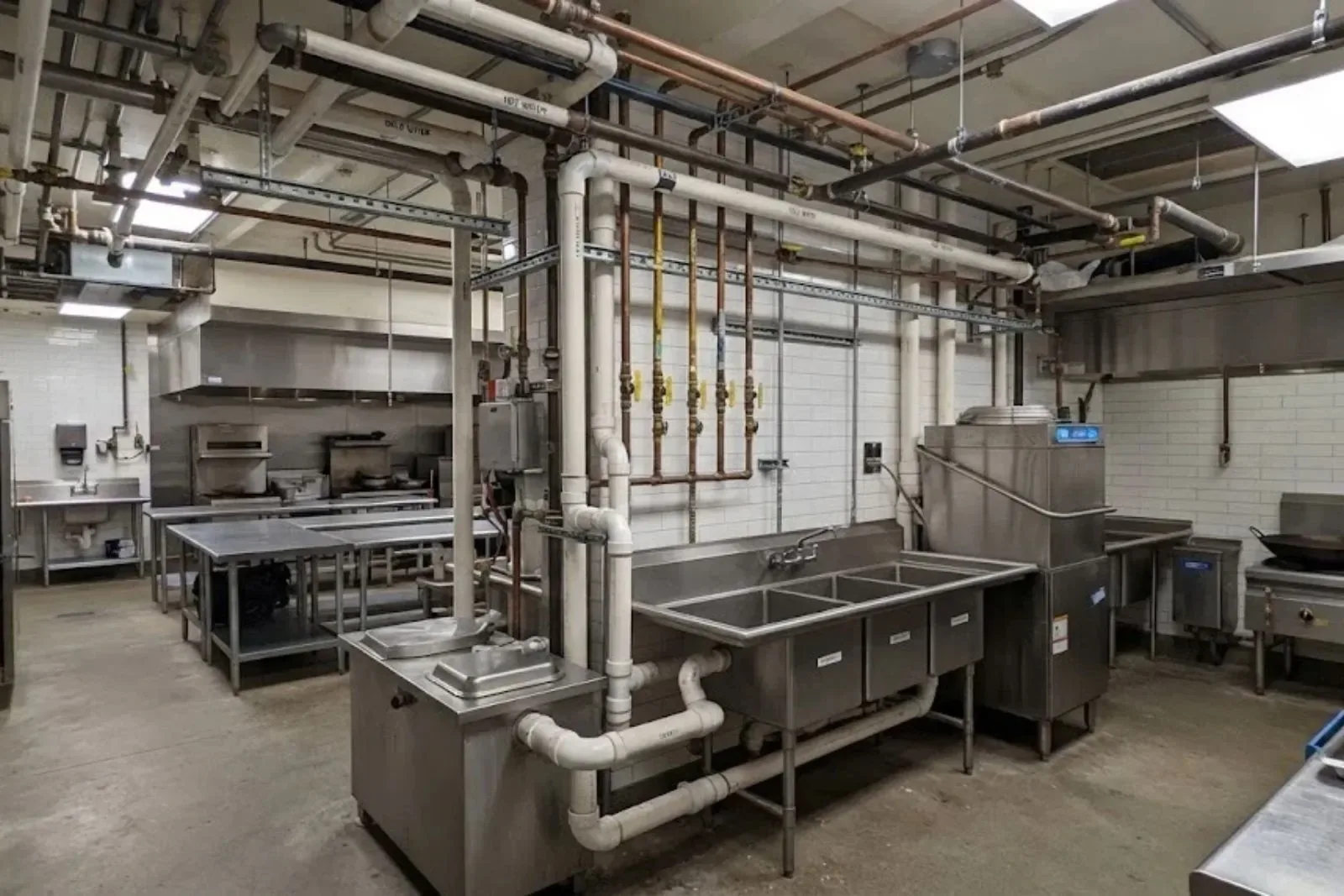
Commercial plumbing in Plainsboro is mostly an after-hours problem: a supply line splits over a ceiling on a Friday night, a restroom backs up before Monday opening, or a restaurant's grease trap overflows mid-service. Call the 24/7 line and, while you wait, close the nearest shutoff valve, keep tenants and customers away from wet floors, and tell building management.
Commercial jobs differ from home calls because the water usually belongs to more than one party. A landlord, a tenant, a property manager and sometimes a neighboring suite are all affected. This page explains how those problems get sorted, what a dispatched plumber can and cannot do on the spot, and what to have ready.
Active leak after hours: what to do first
Property managers and tenants can do these before the plumber arrives.
Find the closest shutoff
Close the suite valve, the riser valve or the building main, whichever is nearest the leak and safe to reach.
Protect people and power
Keep staff out of wet areas and call the building engineer if water is near electrical gear or panels.
Notify management
Tell the property manager and any suites below or beside the leak. Delays turn a one-suite leak into a four-suite claim.
Document before cleanup
Photograph the source, the ceiling, the floor and the affected stock or equipment.
Call the 24/7 line
Give the address, the suite, the access contact and whether the water is still running.
Building type, common failures, what to prepare
Different commercial buildings fail in different ways, which affects what the plumber needs to know.
| Building type | Common plumbing failures | What to prepare |
|---|---|---|
| Multi-tenant office. | Riser leaks, restroom clogs, ceiling drips from the floor above. | After-hours access, a management contact and floor plans. |
| Restaurant or food service. | Grease trap overflow, floor drain backups, dishwasher line leaks. | Trap size, last cleaning date and kitchen shutdown plan. |
| Retail shop. | Slow restroom drains, water heater leaks, hidden slab leaks. | Landlord contact, stock to move and shutoff location. |
| Medical or dental suite. | Sink drains clogging, water heater failures, backflow device tests. | Equipment shutdown steps and infection-control rules. |
| Mixed-use with apartments above. | Stack leaks affecting shops below, shared drain backups. | Both landlord contacts and the tenant list. |
| Light industrial or warehouse. | Floor drain clogs, hose bib freezes, hydrant or sprinkler line issues. | Access to dock doors and a site contact. |
Finding a leak inside a multi-tenant building
Commercial leaks hide behind finished ceilings and inside chases. The location of the stain is rarely the location of the leak, because water runs along pipes and slab before it drips. A plumber starts with the building drawings, a pressure test on isolated sections and moisture readings with a thermal camera, then confirms with an acoustic listening device on pipes and slabs where needed.
Slab leaks, risers inside walls and above-ceiling lines all depend on access. Opening a ceiling in a leased suite needs the tenant's permission and often the landlord's. Plan on coordination time, not just plumbing time. For hidden-leak methods in more depth, see leak detection.
Grease traps and food service drains
A grease trap holds fats, oils and grease so they do not harden in the building drain and the sewer. When it fills, the trap overflows, drains slow down and kitchens smell. Cleaning means pumping out the contents and scraping the trap clean, which is usually a vacuum truck job arranged on a schedule.
Emergency trap overflows are urgent for a restaurant because the kitchen may have to stop. If the main drain beyond the trap is blocked, a plumber can clear it with a cable or a hydro-jet, as described under drain cleaning. Ask your landlord whether the trap is shared with other tenants.
Backflow devices and testing
A backflow preventer keeps dirty water from flowing back into the public water supply. New Jersey rule N.J.A.C. 7:10-10.1 sets the framework for the permit, design and testing of these devices, and public water systems run the programs that enforce it.
Test intervals and who must be certified to perform the test are set through the water provider and the local authority. For Plainsboro, ask NJ American Water and the township Building Division which devices on your property need testing and which testers they accept. Keep the test reports on file.
Information a plumber needs to dispatch the right truck
Having these ready at the time of the call saves a second trip.
- The full street address, suite or unit, and floor.
- A contact who can open the building and the mechanical room after hours.
- Whether water is still running and where the nearest shutoff is.
- Whether the problem affects one suite or several.
- The age and type of piping if you know it.
- Landlord or property manager name and whether they approve emergency work.
- Any building rules on contractor insurance forms or parking.
Forrestal, Village Center and the US 1 corridor
Princeton University began developing the Princeton Forrestal Center office park in the 1970s, so many office buildings in that area are decades old. Older office buildings may have original copper or galvanized risers, shared restrooms and flat roofs with interior drains. Ask your building engineer for riser drawings before a failure, not during one.
Sewer service in Plainsboro splits along the rail line. West of the rail, including the whole Forrestal Center, the Stony Brook Regional Sewerage Authority serves the area. East of it, the Princeton Meadows plant takes over. If a drain backup affects several buildings, the tenant and landlord need to know which system the line joins before anyone calls a utility.
Plainsboro Village Center has about 17 acres, around 110,000 square feet of commercial space and eight rental apartments above retail. A leak in an apartment can drop onto a shop, and the reverse. Keep both landlords' contacts handy.
The township Building Division on Plainsboro Road handles permits for commercial plumbing work. Large institutions such as the medical campus and PPPL nearby run their own facilities teams, and this page does not claim to serve them. Businesses in East Windsor and South Brunswick can use the same dispatch line.
What a plumber cannot decide for you
Who pays is usually set by the lease, not by the plumber. A landlord generally handles building systems and risers, and a tenant handles fixtures inside the suite, but leases differ. A plumber can document the cause and the location and make the repair safe, but cannot assign responsibility.
Some problems also need an engineer, such as a failing riser stack across several floors, a fire sprinkler issue or a structural question after flooding. A plumber will say when a job crosses that line. Commercial plumbing falls under the same state plumbing subcode, the National Standard Plumbing Code, as residential work, and permit applications are signed by the licensed master plumber who represents the contracting business.
What shapes the cost of a commercial plumbing call
Commercial work is priced by scope and access, not by a flat rate.
Emergency versus scheduled
After-hours dispatch and overtime labor cost more than a scheduled weekday visit.
Access and coordination
Waiting for keys, opening ceilings and working around tenants add time.
Pipe size and material
Larger risers and specialty fittings cost more and take longer to repair.
Equipment needed
Hydro-jetting, camera work, leak detection gear or vacuum trucks add equipment and operator costs.
Permits and inspections
Commercial work often needs a permit and inspection, with fees set by the township.
A commercial property or general liability policy may cover sudden water damage, and tenants may need their own contents coverage. Policies differ on gradual leaks and sewer backup. Report quickly and keep invoices and photos.
Call the 24/7 line and a licensed plumber will give a clear price before work starts.
Call (609) 547-1417Commercial Plumbing questions from Plainsboro homeowners
Yes. The 24/7 line takes calls at any hour, and licensed plumbers are dispatched for burst lines, backups and overflows at offices and shops. Have an after-hours access contact ready to speed things up.
It depends on the lease and where the failure is. The landlord typically owns risers and common systems, and the tenant owns fixtures inside the suite. Review your lease and tell the landlord immediately.
We dispatch plumbers for trap problems and overflows. Regular pumping is usually scheduled with a hauler, and a plumber can clear blocked drains beyond the trap.
Test intervals and tester certification rules come from the water provider and the local authority, under the framework in N.J.A.C. 7:10-10.1. Ask NJ American Water and the township which testers they accept.
Often, with pressure tests, thermal imaging and acoustic listening. Access has to be arranged with the tenant and landlord. A plumber can say what is likely before anything is opened.
No. Those large campuses are neighbors and run their own facilities teams. We serve offices, shops, restaurants and multi-tenant buildings.
Many jobs do. The township Building Division on Plainsboro Road issues permits, and the plumber handles the filing. Ask the local construction office when the scope is unclear.
Shop or office plumbing down?
Call the 24/7 line and get a licensed plumber and a clear price before work starts.
Where we dispatch from
We send commercial plumbing crews across Plainsboro and the neighboring towns. Our base is 777 Scudders Mill Rd, Plainsboro, NJ 08536, and the map shows the surrounding towns we serve.