A main sewer clog shows up in several places at once: a toilet that gurgles when the washer drains, a bubbling basement floor drain, or fixtures backing up together. A plumber opens the main cleanout, clears the line with a drain machine or hydro-jet, then runs a camera to see why it clogged. Skip chemical openers and stop running water. Renters should call the landlord or property manager. Talk to dispatch if the problem is happening now.
Signs the main line is blocked, not one drain
A single slow sink is a branch problem. These point to the main.
- Two or more fixtures drain slowly at the same time.
- The toilet gurgles or bubbles when the washing machine empties.
- A basement or lowest-level floor drain backs up or smells.
- Water rises in the tub when you flush an upstairs toilet.
- Plunging a toilet moves water up in another fixture.
- Wet or soft ground, or a sewage smell, near the cleanout or the lawn line.
- The problem returns days after a drain was snaked.
Finding your main cleanout
The main cleanout is a capped pipe, often four inches wide, that gives a plumber direct access to the house drain. In many homes it sits in a basement or crawlspace near where the main line leaves the foundation, or in a utility room. Some sit outside, flush with the ground in a small box.
Townhouses and condos may share one drain, with the cleanout in a common area or a utility closet. If you cannot find one, do not open random caps. Ask your property manager or call a plumber who can trace the line.
A missing or buried cleanout is a common reason a clog takes longer to clear. A plumber then works through a toilet flange or a roof vent, which is slower and riskier for the fixture.
Snake or hydro-jet: what each does to the clog
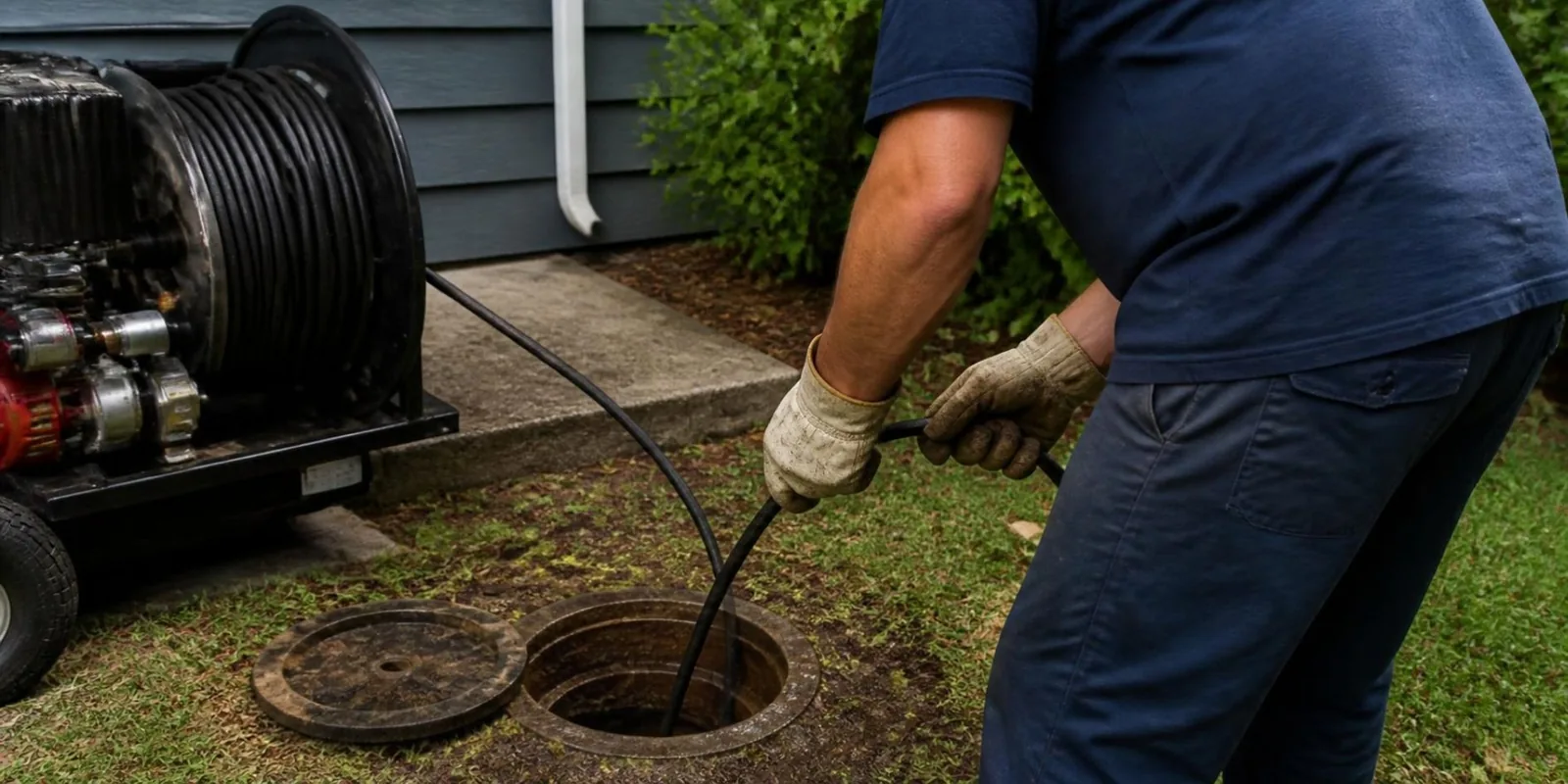
A drain machine, often called a snake or auger, pushes a rotating steel cable into the line. A cutter head chews through roots and punches through soft blockages. It clears a path, but it can leave grease and scale clinging to the pipe wall.
A hydro-jet sends high-pressure water through a nozzle whose rear jets pull the hose forward through the pipe. It scours the wall and flushes debris downstream. Hydro-jetting suits grease buildup and heavy sludge. A cutter head is often the better first tool for a thick root mass.
Neither tool fixes a cracked or collapsed pipe. That is why many plumbers follow cleaning with sewer line cleaning and a camera pass, so the next clog is explained instead of repeated.
What a main line clearing visit usually involves
The order is the same whether the tool is a cable or a jet.
Locate the cleanout
The plumber finds the main cleanout, or traces the line with a locator if none is visible.
Open and relieve the line
The cap comes off slowly because the pipe may hold backed-up water that needs to drain safely into a pan, bucket, or floor drain.
Clear the blockage
A cutter head or jetting nozzle goes in until water flows freely, then the tool is pulled back while the pipe is flushed.
Test the flow
Fixtures are run together so the plumber can see whether the whole house drains properly, not just one sink.
Camera pass
A camera on a push cable shows roots, cracks, bellies, or grease and records what to fix before the next clog.
What not to do while the line is backing up
Stop running water. Washers, showers, and dishwashers all push more water toward the same blocked pipe, and the lowest drain in the house gets the overflow.
Skip chemical drain openers in a main line. They sit above the clog, they heat up, and they can harm pipe joints, hands, and the plumber who opens the line later. Flushing wipes labeled flushable is also a poor idea. Wipes do not break down like toilet paper and tangle with roots and grease.
Which sewer system serves your Plainsboro home
Plainsboro has two sewer providers, split by the rail line. Homes and buildings east of the rail right-of-way are served by the Princeton Meadows sewage treatment plant, a regulated public utility off Maple Avenue. Homes west of it, including all of Princeton Forrestal Center, connect to the Stony Brook Regional Sewerage Authority.
Middlesex County Utilities Authority does not provide sewer service to any land in the township, even though Plainsboro sits inside its district. So a street-side blockage past your property line is a call to the sewer provider that serves your street, not to the county.
Before you call, check which side of the railroad you are on. Tell the plumber, and ask your sewer provider who owns the pipe between your cleanout and the public main.
Where this comes from: township Utility Service Plan (master plan chapter) and NJDEP water quality management plan amendment.
Owner, landlord or association: who makes the call
If you own a single-family house, the line from the house to the public main is usually yours to maintain, though ownership of the last stretch can vary. Confirm it with your sewer provider if the clog sits near the street.
Renters should report a backup to the landlord or property manager right away and photograph any water damage. Condo and townhouse owners should check the association documents, because the main may be a shared pipe.
Either way, the work itself must be done by a master plumber, an authorized plumbing contractor, or their W-2 employees. You can check any NJ plumber through the Division of Consumer Affairs License Verification System.
Why the camera follow-up matters
A cleared line can feel fixed. But a clog that returns within weeks usually has a cause: roots at a joint, a sag that holds water, grease buildup, or a cracked section. A camera shows which.
After the line is open, a sewer camera inspection records the pipe from the cleanout to the main. If it shows damage, you can compare repair options with real video in hand. If the pipe is sound, the answer may simply be what goes down the drain.
Neighboring towns differ in who maintains the public sewer. In West Windsor, the township runs its own collection system and sends flow to the same regional authority. In Princeton, confirm arrangements with the municipality before assuming anything. According to New Jersey One Call, utility lines must be marked, which takes three business days' notice to 811, before anyone digs to reach the line.
Questions readers ask
Look for several fixtures backing up or gurgling at once, especially the lowest drain in the house. One slow sink usually points to a branch drain instead.
It is not a good idea. The product sits above a full blockage, can damage pipe and skin, and complicates the plumber's work later.
There is no fixed schedule. Lines with roots or a history of backups benefit from a camera check and periodic cleaning, while healthy lines may never need it.
A snake cuts a path through the clog. A hydro-jet uses pressurized water to scour the pipe wall. Plumbers pick based on whether the problem is roots, grease, or soft debris.
It depends on the side of the railroad. East of the rail line the Princeton Meadows plant serves the area, and west of it, including Forrestal Center, the Stony Brook Regional Sewerage Authority does.
When every drain in the house slows at once, the problem sits in the main line, not in a sink.
Call (609) 547-1417Where we dispatch from
Our plumbers work across Plainsboro and the neighboring towns on the map. Our base is 777 Scudders Mill Rd, Plainsboro, NJ 08536, and the map shows the surrounding towns we serve.