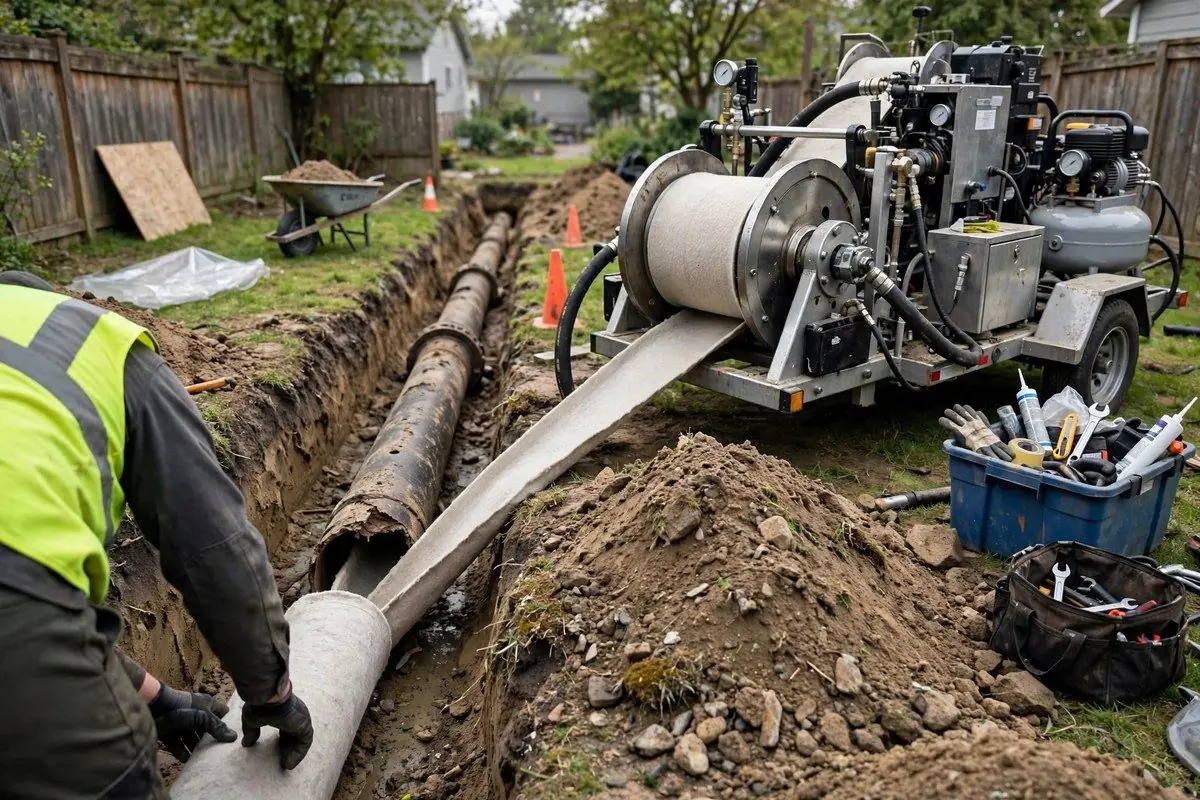
Cured-in-place pipe lining (CIPP) pushes a resin-soaked tube into an existing sewer pipe, inflates it against the wall, and lets it harden into a new pipe inside the old one. It fits cracked, leaky, or root-prone pipe that is still straight and in one piece. It does not fit collapsed, badly offset, or deeply bellied pipe. A camera inspection comes first. Lining repairs the pipe, not the cause of the roots. Talk to dispatch if the problem is happening now.
What a cured-in-place liner actually is
The liner starts as a flat felt or fiberglass tube. A crew soaks it with epoxy or polyester resin, then feeds it into the damaged pipe through a cleanout or a small access hole. Air or water pressure pushes the tube open until it presses against the old pipe wall.
Then the resin cures. Crews use hot water, steam, or ultraviolet light, depending on the system. Once hard, the resin leaves a smooth, jointless pipe inside the old one. The new wall is thin, so the inside diameter shrinks only a little.
That is why lining targets problems in the pipe wall itself: hairline cracks, open joints where roots creep in, and pinholes from corrosion. The old pipe still carries the load of the soil above it. The liner mostly seals and smooths.
Lining, pipe bursting and open trench side by side
Each method repairs a sewer lateral differently, and the camera findings pick the winner.
| Repair method | Good for | Limits |
|---|---|---|
| Cured-in-place lining. | Cracks, leaking joints, root entry points, pipe that is still round and aligned. | Cannot fix collapse, big offsets or deep bellies. Slightly smaller inside diameter. |
| Pipe bursting. | Pipe too broken to line, or pipe that needs a full replacement without a long trench. | Needs entry and exit pits. Buried utilities nearby can complicate it. |
| Open trench replacement. | Collapsed pipe, severe sags, sections that must change slope or route. | Most digging, yard and driveway damage, and a longer restoration job. |
| Spot repair (short dig). | One short bad section, such as a single broken joint. | Leaves the rest of the old pipe as it is. |
A plumber can only rank these after seeing the inside of the pipe on video.
Conditions that point toward or away from lining
A good candidate and a poor one look different on camera.
- Lining usually fits when the camera shows hairline cracks along the pipe wall.
- Lining usually fits when roots enter only at joints and the pipe is otherwise straight.
- Lining usually fits when an older clay or cast iron lateral is intact but weeping.
- Lining is a poor fit when the pipe has collapsed and the camera cannot pass.
- Lining is a poor fit when joints are pulled apart or offset by more than the pipe wall thickness.
- Lining is a poor fit when a belly holds standing water deep enough to pool the resin.
- Lining is a poor fit when the pipe has no clean access point and needs a new cleanout first.
How a lining job unfolds on site
The order matters more than the speed.
Camera inspection
A crawler or push camera records the whole lateral so the plumber can mark cracks, offsets, bellies, and every branch connection.
Cleaning the pipe
Roots and scale come out with a cutter or hydro-jetting, because resin bonds poorly to a dirty wall.
Liner insertion
The resin-soaked tube goes in through the cleanout and is inflated against the pipe wall.
Curing
Hot water, steam, or UV light hardens the resin. Curing time depends on pipe length and diameter.
Reinstating connections
A robotic cutter opens the liner at each side branch so flow can enter again, and a final camera pass checks the result.
A liner repairs the pipe, not the reason roots came
Roots head for a sewer line because it leaks warm, nutrient-rich moisture. A liner seals those leaks, which removes the invitation at the joints. It does not change the tree, the shrub, or the soil moisture around the pipe.
Roots can still push at the ends of the liner, at lateral cuts, and at any unlined connection upstream or downstream. Homeowners across the line in South Brunswick face the same limit. Ask where the liner starts and stops, and whether a periodic camera check or a sewer line repair plan covers the rest of the run.
Permits, digging and who to ask, Plainsboro, NJ
New Jersey's plumbing subcode is the National Standard Plumbing Code. The township Building Division on Plainsboro Road lists Plumbing among its subcode sections. Ask them whether a liner or any sewer repair on your lot needs notice or a permit, because the answer depends on the scope of work.
State rule N.J.A.C. 5:23-2.17A treats replacement of existing piping with approved material of like capacity as minor work. That still means notice to the local enforcing agency before work starts. Do not assume a liner is exempt without asking.
Any access pit, cleanout install, or trench calls for NJ One Call. Dial 811 at least three business days before digging. Hand-dig within two feet of marked lines, and recheck the marks after heavy rain.
Where this comes from: township Building Division permit page, N.J.A.C. 5:23-2.17A text and NJ One Call (811) public notice.
Questions worth asking before you agree to lining
Ask to see the camera video, not a summary. The video should show the cracks or root entry that justify lining, and it should show that the pipe is round and passable end to end.
Ask also about the cleanout. A lined lateral should end with an accessible cleanout, so a future camera or jetter can reach the pipe without another dig. If none exists, a new cleanout is often part of the job.
Ask which resin and curing method will be used, how long the liner is, and how side connections get reopened. Ask what happens if the camera finds a collapse halfway through. A plain answer means the plumber has thought it through.
You can verify any NJ plumber's licence with the State Board of Examiners of Master Plumbers through the Division of Consumer Affairs License Verification System. If a bid skips the camera step, get a second opinion from a sewer camera inspection before signing.
Questions readers ask
Manufacturers rate liners for decades, but the real lifespan depends on the installation and the condition of the host pipe. Ask the contractor for the written warranty terms and what voids them.
Roots must be cut out first, usually with a mechanical cutter or hydro-jet, so the resin can bond to a clean wall. A camera pass afterward confirms the pipe is clear before the liner goes in.
It seals the cracks and joints roots use to enter, but it does not remove the tree or the moisture that attracts them. Roots can still press in at the ends of the liner or at unlined connections.
No. A collapsed or badly offset pipe blocks the liner and leaves nothing sound to support it. Those pipes need spot excavation, pipe bursting, or a full open-trench replacement.
Start with the township Building Division on Plainsboro Road, which handles Plumbing permits. Also ask your sewer provider, since homes east of the railroad and homes west of it are served by different systems. Neighboring towns differ: West Windsor runs its own township sewer system, so the same repair there involves a different office.
A liner can seal a cracked or leaking pipe without a trench, but only when the pipe is still in one piece.
Call (609) 547-1417Where we dispatch from
Our plumbers work across Plainsboro and the neighboring towns on the map. Our base is 777 Scudders Mill Rd, Plainsboro, NJ 08536, and the map shows the surrounding towns we serve.