
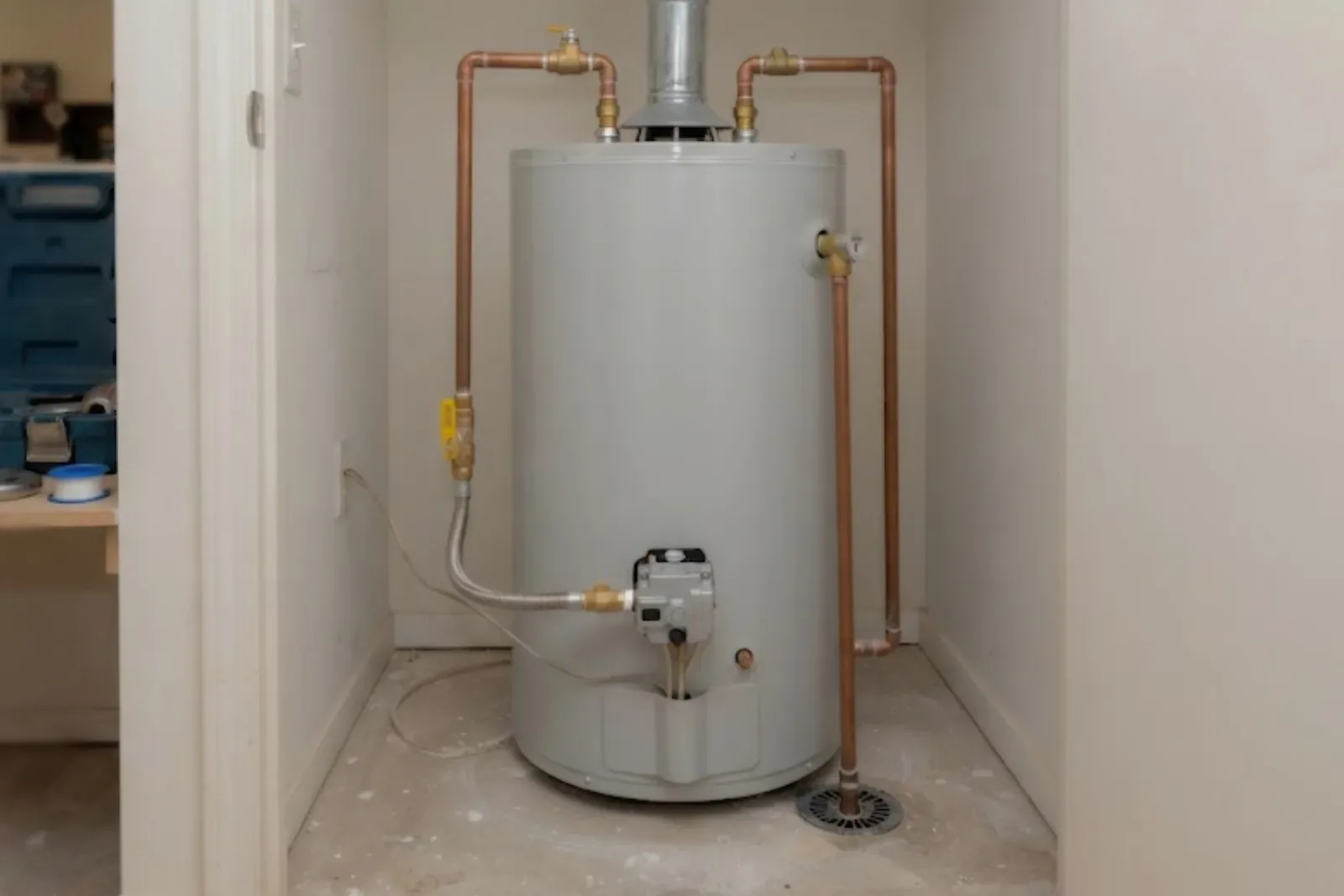
Yes, plan on a permit process. New Jersey treats a replacement of like capacity as minor work under N.J.A.C. 5:23-2.17A: notice to the local enforcing agency before work starts, a permit application within five business days, a fee and an inspection. Plainsboro's Building Division lists water heaters among the maintenance items that need permits. A different capacity, new venting or gas work may fall outside minor work, so ask the construction office first. Talk to dispatch if the problem is happening now.
Why 'no permit needed' is the wrong answer
You will hear that a straight water heater swap needs no permit. The state rule is more specific. For minor work, the permit does not have to be issued before work can begin, but the owner or contractor still has to give notice first and then apply.
That is a lighter process, not an exemption. If a plumber tells you nothing is required, ask them to point to the notice and the application, because both are part of the rule.
From notice to certificate: the order of events
For a like-for-like swap, the minor work rule lays out this sequence.
Give notice
Before work starts, the owner or the contractor tells the enforcing agency. The rule allows the notice to be oral or written.
File the application
A permit application goes in within five business days of the notice, on the township's plumbing permit form.
Pay the fee
The fee is paid before the permit issues. It is set by the municipality, so ask what it is rather than assuming.
Do the work
The plumber swaps the unit, reconnects the supply and relief lines, and checks venting and gas or electrical hookups.
Request the inspection
The agency is expected to inspect within three business days of the request, or on another date agreed up to thirty days out.
Receive approval
After a passing inspection the construction official issues a certificate of approval for your records.
Like-for-like or something bigger: when to phone the Building Division
The minor work rule covers a new heater of like capacity. Anything else is a question for the construction office.
| Your job | How the NJ rule reads | What to do |
|---|---|---|
| New tank, same capacity, same spot. | Minor work: notice, application, fee, inspection. | Have the plumber give notice and file. |
| Larger or smaller capacity. | Outside the 'like capacity' wording. | Ask the construction office first. |
| Tank replaced with tankless. | Often involves venting or gas changes. | Ask the construction office first. |
| New venting or flue relocation. | Not covered by the minor work wording. | Ask the construction office first. |
| New gas line or electrical circuit. | Separate work that may need its own review. | Ask the construction office first. |
| Failure on a weekend. | Notice can be oral, then the application follows. | Document the date and call the office when it opens. |
Where the rule text does not clearly cover your job, the local construction office decides, so ask before you sign.
Who is allowed to do the work in New Jersey
State rules say plumbing work may be performed only by a master plumber, an authorized plumbing contractor, or employees whose pay is reported on a W-2. A handyman or a friend with tools does not qualify, even for a simple swap.
You can check a plumber yourself. Use the License Verification System run by the NJ Division of Consumer Affairs, which covers licences issued under the State Board of Examiners of Master Plumbers. If the business cannot give you the name it is licensed under, treat that as a reason to keep looking.
When you hire through water heater installation, ask who will sign the permit application. That is a normal question and a clear answer is a good sign.
Questions to ask before the old tank comes out
Five minutes on these questions heads off most permit surprises.
- Who gives notice to the Building Division, and when?
- Is the permit fee in your price, or added at cost?
- Is the new heater the same capacity as the old one?
- Will venting, the gas line or the electrical supply change?
- Who schedules the inspection, and will someone need to be home?
- Will I get a copy of the certificate of approval?
- Can I see the plumber's licence in the state verification system?
What an inspector typically looks at
The inspection is a short visit focused on the parts that can hurt someone. Inspectors generally check the temperature and pressure relief valve and its discharge pipe, the venting on a gas unit, the gas connection and shutoff, and the electrical hookup on an electric unit. They also look for an expansion tank where the system calls for one, and for supply connections that are tight and dry.
You can prepare with simple steps. Keep the area around the heater clear so the inspector can see the valve and the vent. Have the permit number handy, and make sure someone can open the door when the visit is scheduled. A failed item is usually a small fix, and the plumber corrects it and asks for a re-inspection.
The Building Division on Plainsboro Road, Plainsboro, NJ
According to Plainsboro's permit page, permits are needed for maintenance items such as furnace or HVAC replacements and water heaters. The Building Division, which handles code enforcement for the township, is on Plainsboro Road, and its subcode sections include plumbing. Your plumber's application goes there, not to the county.
For a straightforward swap, tell the office what you plan and follow its instructions on forms and timing. For anything that changes capacity, venting or gas work, ask the division how it classifies the job before you buy equipment. That one call can save a return trip.
Where this comes from: N.J.A.C. 5:23-2.17A text and township Building Division permit page.
Neighbors with different offices
If you are comparing prices for a relative's house, check where it sits. In East Windsor the Construction Code Office is at the municipal building on Lanning Boulevard, and in West Windsor the Code Enforcement and Construction office is on Clarksville Road.
South Brunswick handles construction code at the municipal building on Ridge Road. Each office sets its own fees and forms, so a plumber working outside their usual town should confirm the steps there rather than reuse Plainsboro's. For a full replacement job, water heater replacement covers what the visit involves.
Questions readers ask
Plan on one. Plainsboro's Building Division says water heaters need permits, and the NJ minor work rule still requires notice before work and a permit application within five business days.
The NJ rule says replacement with a new water heater of like capacity. A different size, new venting or gas work may be outside that wording, so ask the construction office.
The fee is set by the township and paid before the permit issues. Ask your plumber whether it is in the quote or added at cost.
The rule allows notice to be oral, and the application follows within five business days. Keep a note of when the work was done and contact the Building Division when it opens.
State rules limit plumbing work to master plumbers, authorized plumbing contractors and their W-2 employees. Ask the Building Division what applies to an owner before you try it.
Yes if the plumber is licensed in NJ, but the permit still goes to Plainsboro's Building Division. Other offices, such as West Windsor's on Clarksville Road, have their own fees and forms.
A like-for-like swap is lighter paperwork, not no paperwork.
Call (609) 547-1417Where we dispatch from
Our plumbers work across Plainsboro and the neighboring towns on the map. Our base is 777 Scudders Mill Rd, Plainsboro, NJ 08536, and the map shows the surrounding towns we serve.