
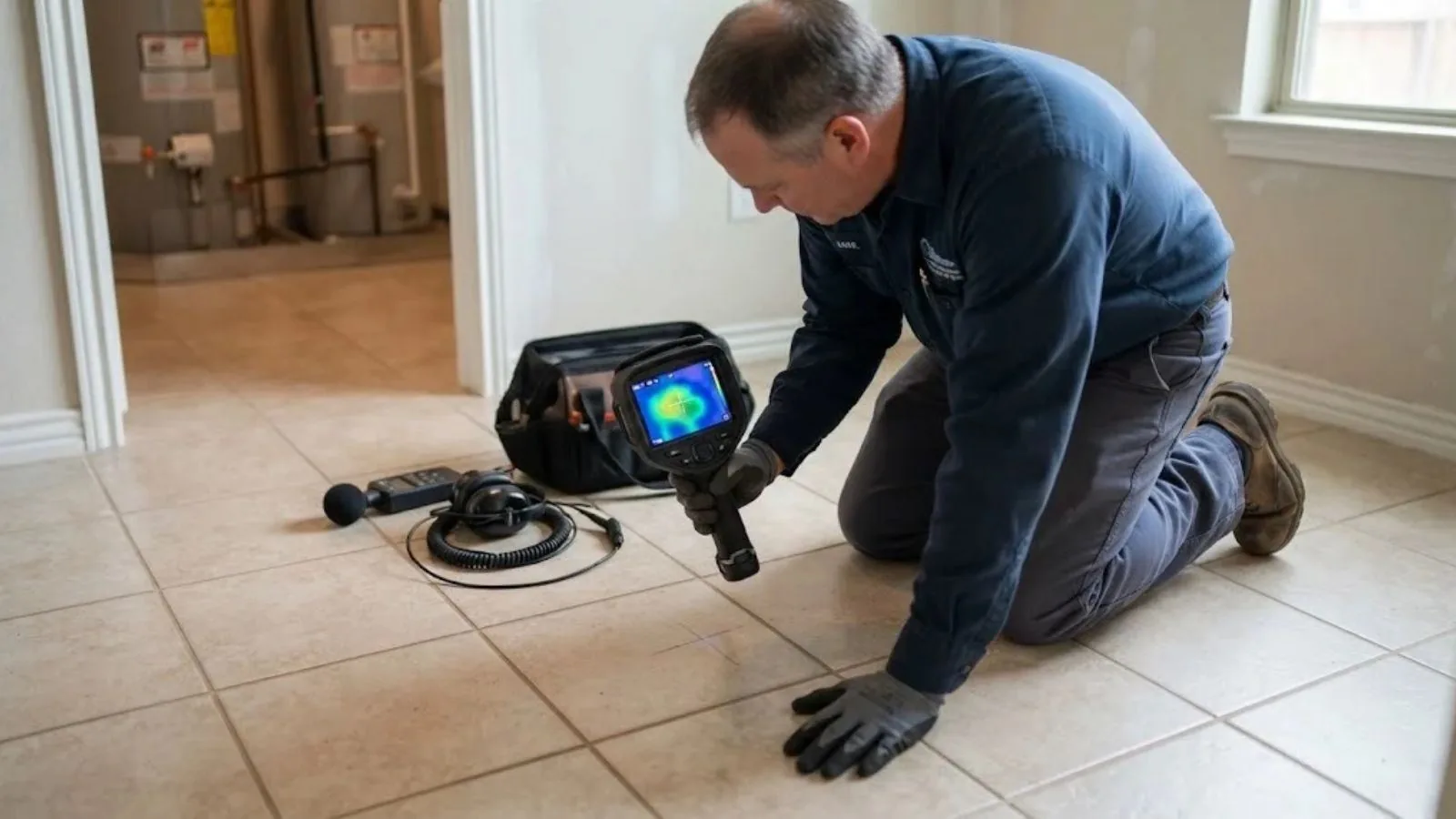
Leak detection works by narrowing down. First prove water is moving with the meter test, with every fixture off. Then split the house into suspects: toilets by dye test, visible pipes and appliances, then the line from the meter to the house. A plumber adds tools for hidden leaks, such as acoustic microphones, thermal cameras and pressure tests. In Plainsboro, remember that seasonal high water tables can make groundwater look like a leak. Talk to dispatch if the problem is happening now.
The meter test: proof that water is moving
This takes about fifteen minutes and needs no tools beyond a flashlight.
Turn everything off
Stop the dishwasher, washing machine, ice maker and irrigation. Make sure nobody runs a tap or flushes during the test.
Find the meter
Look in the basement or utility area, or in a ground box near the street. Lift the cover carefully and watch for insects and standing water.
Read the leak indicator
Most meters have a small triangle, star or dial that spins when any water moves. If it turns with everything off, water is going somewhere.
Note the register and wait
Write down the reading, wait fifteen to thirty minutes without using water, and read again. A change with all fixtures off confirms a leak.
Shut the main and retest
Close the main shutoff inside the house and look at the meter. If the indicator stops, the leak is inside. If it keeps moving, the leak is between the meter and your house.
Toilets cause more phantom bills than any pipe
A flapper that does not seal lets water trickle from the tank into the bowl all day. It is quiet, it wastes a lot, and it makes the meter move. Put a few drops of food coloring in the tank, do not flush, and wait fifteen minutes.
If color shows up in the bowl, the flapper or fill valve is leaking. That is a cheap part for a plumber doing toilet repair work, and sometimes a homeowner fix. Test every toilet in the house, including the one nobody uses.
Do the same quick check at the water heater, the washing machine hoses and under sinks. Look for drips, mineral crust, rust trails and swollen cabinet floors.
Signs, likely sources and what to check first
Use this table to match what you see with the first thing worth checking.
| What you notice | Likely source | First check |
|---|---|---|
| Meter moves with everything off. | Toilet, fixture or hidden pipe. | Dye test every toilet, then close the main and retest. |
| Warm spot on a floor. | Hot water line under a slab or floor. | Shut off water heater supply and see if the spot cools. |
| Musty smell, no visible water. | Wall or ceiling pipe leak. | Check the room above and below for stains and soft drywall. |
| Wet lawn or soggy patch in dry weather. | Service line or irrigation. | Close the main inside, retest the meter, check irrigation zones. |
| Low pressure plus a running sound. | Pipe break or running fixture. | Listen at the main valve, then at each fixture. |
| Wet basement after rain only. | Groundwater, not a pipe. | Check whether the meter stays still when it is damp. |
A leak that spreads only after a rainstorm is more likely groundwater than a pipe.
What a plumber adds to your own checks
Acoustic detection uses a sensitive microphone or a ground microphone to hear the hiss or buzz of pressurized water escaping. The technician listens at valves, fixtures and along the floor or yard, and the sound is loudest above the leak.
Thermal cameras show temperature differences. A hot water leak warms a patch of floor or wall, and a cold leak can cool one. The camera does not see through walls, it reads surface temperature, so it works best on hot lines and radiant systems.
Pressure testing isolates sections of pipe. A gauge on a closed system that falls over time confirms a leak in that section. Tracer gas is sometimes used when the sound is too faint, and a camera can follow a drain line when the suspect is sewage rather than supply.
A leak is not always a pipe
Condensation on cold pipes, a failed window seal, a roof leak and a bathroom fan venting into the attic can all leave stains that look like plumbing. A pro will often check these before opening a wall.
If the meter holds still and a stain keeps appearing, the plumbing may be fine. Do not cut drywall until the meter test says water is moving.
Insurance and documentation
Many homeowner policies cover sudden water damage, such as a pipe that bursts. They often exclude damage that built up slowly over time, and a long unnoticed leak can fall on the wrong side of that line. Read your policy or ask your agent how it treats gradual leaks.
Take photos of the damage, the meter reading and the leaking part before repairs. Keep the old part if you can. A written leak report from the plumber helps your claim, and it is worth asking for one when you book a professional leak detection visit.
High water tables and the NJ American Water line, Plainsboro, NJ
Plainsboro's township Land Use Plan says flood hazard areas, wetlands and seasonal high water tables limit development in parts of the township. The Stormwater Management Plan lists flooding along roads such as Mapleton Road, Schalks Crossing Road and Dey Road. In wet months, groundwater can seep into low areas and mimic a leak.
The practical test is the meter. If the meter is still with every fixture off and the damp area appears after rain, suspect the soil, not the pipe. If the meter moves, treat it as a leak whatever the weather.
Plainsboro's water comes from NJ American Water. The township Contact Us page lists the company's emergency and general inquiry line, which is the number to call if you see water bubbling at the street or suspect the meter side of the connection.
Where this comes from: township Land Use Plan, township stormwater management plan and township Contact Us page listing NJ American Water.
When the leak is outside the house
A leak between the meter and the house sits on the water service line. It may show up as a wet lawn in dry weather, a sudden drop in pressure or a meter that spins with the house shut off. Digging triggers a legal step, which is calling 811 for utility markouts before a shovel goes in.
Fixing that line is its own job, usually handled by a water service line repair crew. It also touches lead: New Jersey law requires water systems to replace lead service lines by July 2031, so ask your water provider about the material of your line before you replace anything.
In East Windsor the water comes from the East Windsor Municipal Utilities Authority's own wells, so the first call is to a different utility. In Princeton, as in Plainsboro, the provider is NJ American Water. According to the EPA, leaks in an average home can waste nearly 10,000 gallons of water a year, which is why the meter test is worth doing before anyone opens a wall.
Questions readers ask
Run the meter test. With every fixture off, a moving leak indicator or a changing reading means water is leaking somewhere in the system.
Yes. Parts of the township have seasonal high water tables, and groundwater can seep into basements and low spots after wet weather. If the meter is still, the water is not coming from your pipes.
Add a few drops of food coloring to the tank, do not flush, and wait about fifteen minutes. Color in the bowl means the flapper is leaking.
It reads surface temperature, not the pipe itself. A hot water leak can warm the wall surface, which the camera shows, but it is a clue, not proof.
It depends on the policy. Sudden damage is often covered, and slow damage over a long time is often excluded. Ask your agent before repairs and keep photos and records.
Call NJ American Water through the number on the township Contact Us page. It is the water provider for Plainsboro, so it is the right first call for street-side problems.
Most hidden leaks can be narrowed down with a water meter and a few minutes.
Call (609) 547-1417Where we dispatch from
Our plumbers work across Plainsboro and the neighboring towns on the map. Our base is 777 Scudders Mill Rd, Plainsboro, NJ 08536, and the map shows the surrounding towns we serve.