
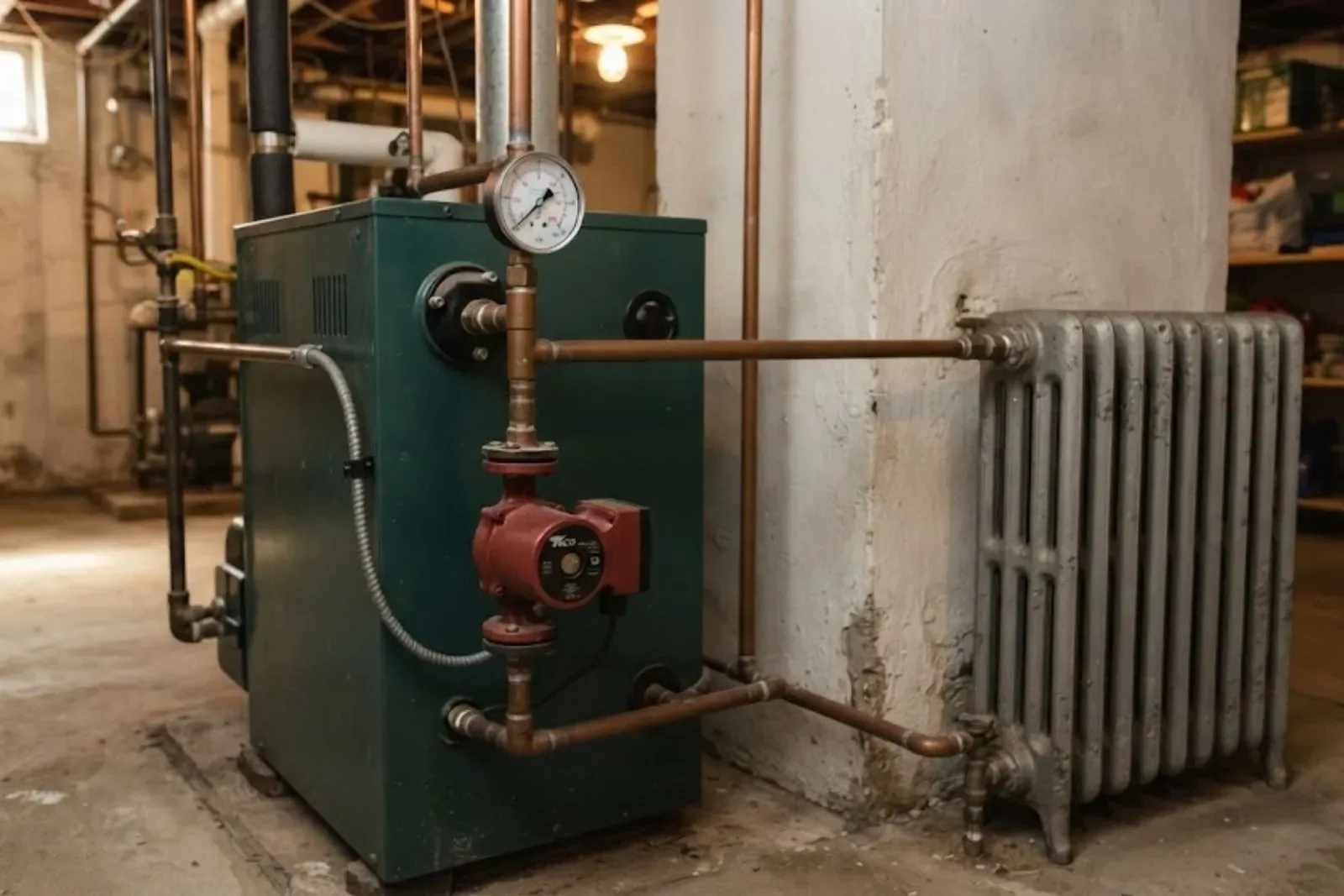
A heat exchanger is the metal chamber where burner heat passes into your heating water. If it cracks, combustion gases and water can end up where they should not, which makes it a safety problem, not only a repair. Warning signs include soot, an odd smell, a carbon monoxide alarm, water at the casing and short cycling. As general professional practice, a confirmed crack usually means replacement, not a patch. If an alarm sounds, leave and call 911. Talk to dispatch if the problem is happening now.
Carbon monoxide alarm or gas smell: do this first
If a carbon monoxide alarm sounds, get everyone out into fresh air, including pets, and call 911 from outside. Do not go back in to silence the alarm or to shut the boiler down. Headache, dizziness and nausea in several people at once is a reason to treat the alarm as real.
If you smell gas, leave right away and call the gas utility from outside the house. PSE&G's number appears on the township's Contact Us page. Do not flip switches, light anything or use a phone inside.
What a boiler heat exchanger does
In a hydronic boiler, a gas or oil burner heats a metal chamber, and water circulating through that chamber carries the heat to your radiators or baseboards. The metal wall between the flame and the water is the heat exchanger. It keeps combustion gases on one side and heating water on the other.
This page covers hydronic boilers, which heat water. Ducted furnaces have their own heat exchangers and different failure signs, and they are a separate question for an HVAC specialist. Water heaters have their own tank and burner design and are covered in the water heater pages instead.
Signs the exchanger may be failing
No single sign proves a crack, but several together call for a stop-and-inspect.
- Soot on or around the boiler, the vent or the draft hood.
- A sharp, chemical or burning smell when the boiler fires.
- A carbon monoxide alarm that trips when the heat is on.
- Water dripping from the casing or pooling under the boiler.
- Frequent top-ups to the system's water pressure.
- A burner flame that is yellow, lazy or lifts off the burner.
- The boiler turning on and off in short bursts, called short cycling.
- Rust-colored streaks or scale on the boiler's outer jacket.
Symptom, likely meaning, next step
Many symptoms have simpler causes, so use this to decide how urgent the call is.
| Symptom | What it may mean | Next step |
|---|---|---|
| CO alarm sounds. | Combustion gas escaping or poor venting. | Leave, call 911, do not re-enter. |
| Soot around the boiler. | Incomplete combustion or a blocked flue. | Shut the boiler off and call a plumber. |
| Water at the casing. | Leaking fitting, relief valve or a failed exchanger. | Turn off the boiler and water feed, then call. |
| Short cycling. | Oversized unit, low flow, thermostat or sensor fault. | Call for a service visit, not an emergency. |
| Frequent pressure top-ups. | A leak somewhere in the system. | Look for wet spots and call for leak checking. |
| Odd smell at startup. | Dust burn-off or a combustion problem. | If it lasts past the first minutes, shut off and call. |
A plumber confirms a crack with a combustion analyzer, a camera on the burner side and a pressure test.
Why a cracked exchanger usually means replacement
As general professional practice, a heat exchanger with a confirmed crack is not patched. The wall is under heat stress every cycle, and a weld or sealant over a crack is rarely trusted to hold. Many manufacturers do not offer exchanger-only repair on a sealed unit, which pushes the decision toward the boiler as a whole.
Some boilers have a replaceable exchanger or heat block, and that is a real option on certain models while the rest of the unit is sound. Whether it makes sense depends on the age of the boiler, whether the part is still made, and what else is worn.
Ask the plumber to show you the crack or the test result, not just describe it. A written finding with the combustion readings lets you get a second opinion before you commit to a large purchase. If the boiler is unsafe, though, it should stay off while you decide.
Repair or replace: how the decision usually goes
Each row is general practice and not a promise about your boiler.
| Situation | Leans toward | Why |
|---|---|---|
| Small leak at a valve or fitting. | Repair | The exchanger itself is intact. |
| Confirmed crack, unit is old. | Replace | A new exchanger rarely beats a new boiler. |
| Confirmed crack, unit is young, part exists. | Possible repair. | Ask for the part price and the warranty terms. |
| Scale or blockage with no crack. | Repair or cleaning. | The chamber can often be descaled. |
| Repeated short cycling after fixes. | Evaluate sizing. | The boiler may be oversized for the house. |
Winter outages and gas safety, Plainsboro, NJ
In the Trenton area normals, January averages a low of 24.3 F. A boiler that has to be shut down in a cold snap is more than an inconvenience, because pipes in exterior walls can freeze while the house is without heat. If a boiler must stay off, ask the plumber how to protect the system and which rooms to heat in the meantime.
Plainsboro's Building Division lists furnace and HVAC replacements among the maintenance items that need permits. Boilers are not named on that page, so ask the division whether your replacement needs a permit before you order equipment. Only a licensed master plumber, or an authorized contractor, may do the plumbing side, and you can verify a licence through the NJ Division of Consumer Affairs.
Where this comes from: NOAA 1991-2020 climate normals for Trenton, township Building Division permit page and township Contact Us page.
Getting a service call and a second look
For a suspected leak or soot problem, schedule boiler repair and expect the plumber to shut the unit off if the readings are unsafe. Get the findings in writing, with the combustion numbers and the location of any crack. If replacement is recommended, the piping, valves and venting around the new boiler fall under plumbing installation, so ask that each be listed in the quote.
Homeowners in East Windsor and West Windsor face the same winter, since both are in Mercer County like the Trenton airport station. In either town the safety steps above apply unchanged, and the permit office differs from Plainsboro's. Carbon monoxide alarms should be listed to the UL 2034 standard and replaced on the manufacturer's schedule, because an old alarm may not sense what it was built to catch.
Questions readers ask
As general practice, a confirmed crack usually leads to replacement of the boiler or the exchanger assembly, not a patch. Some models allow a replacement exchanger, so ask for the part availability and warranty in writing.
It can be, because it can let combustion gases and water mix with what they should be kept apart from. Treat a carbon monoxide alarm as real and leave the house.
The failure is similar in principle, but a boiler heats water, not air, so a crack often shows up as leaking water. Ducted furnaces are a separate question for an HVAC specialist.
Trenton area normals show an average January low of 24.3 F, so protect exposed pipes quickly. Shut off the boiler if you see soot or smell fumes, and keep the house warm with safe sources until a plumber arrives.
The township's permit page names furnace and HVAC replacements and water heaters. It does not name boilers, so ask the Building Division before you order equipment.
Safety first, then the decision: what a failing heat exchanger means for your boiler.
Call (609) 547-1417Where we dispatch from
Our plumbers work across Plainsboro and the neighboring towns on the map. Our base is 777 Scudders Mill Rd, Plainsboro, NJ 08536, and the map shows the surrounding towns we serve.