
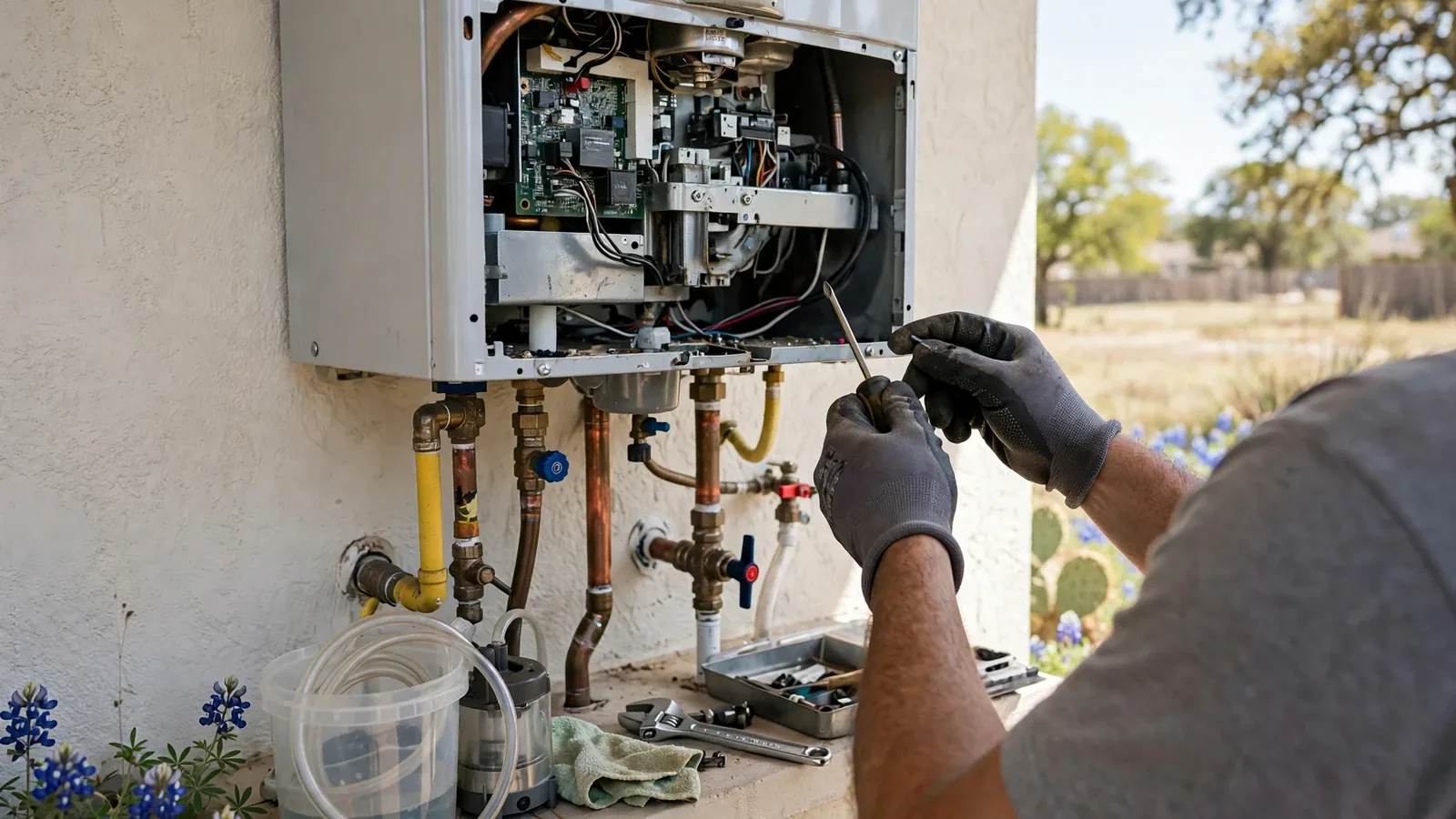
Flush it as often as the manufacturer's manual says, and sooner if your water is hard. A yearly flush is a common interval, but check yours. The US Department of Energy says a tankless unit lasts about twenty years with proper maintenance, and scale is a main threat to that. New Jersey American Water does not publish a hardness figure for this area, so test your tap with a strip or lab kit. Talk to dispatch if the problem is happening now.
What scale does inside a tankless unit
A tankless heater pushes water through a narrow heat exchanger at high temperature. Minerals in the water drop out as the water heats, and they coat the inside of that exchanger. The coating acts like insulation, so the burner works harder to hit the same temperature.
The first signs are subtle. Hot water takes a little longer to arrive, the temperature wobbles during a shower, or the flow at a faucet seems weaker than it was. A flush dissolves the coating and rinses it out before it blocks passages and triggers an error code.
Scale does not hurt every unit at the same speed. A busy household with long showers runs more water through the exchanger each week than a couple who is away often. That is why a calendar date alone is a weak guide, and why watching the unit matters as much as following the manual.
Why your manual beats any blog's schedule
We could not verify a Department of Energy flushing schedule, so this guide does not quote one. The manufacturer's manual is the authority for your model, because it names the right solution, the right contact time and whether your unit has a built-in service routine.
If you lost the manual, the model number on the unit's label usually lets you find it online. Follow its interval, then shorten the interval if your water or your usage matches one of the conditions in the table below.
Conditions that shorten the flush interval
These situations tend to speed up scale, so treat the manual's interval as a maximum.
| Condition | Effect on scale | What to do |
|---|---|---|
| Hard water. | More minerals drop out as water heats. | Test the tap and shorten the interval if hardness is high. |
| High temperature setting. | Heat speeds mineral buildup. | Set the unit near 120 F, which DOE says is adequate for most households. |
| Recirculation line. | Hot water cycles through the exchanger more often. | Check the manual for its recirculation guidance. |
| No service valves installed. | Flushing is difficult without isolation valves. | Ask a plumber to add them. |
| Water softener on the house. | Fewer minerals reach the unit. | Follow the manual, and keep the softener working. |
| Long gaps with no service. | Scale hardens and is harder to dissolve. | Flush now, then set a calendar reminder. |
The DOE notes that a lower setting slows mineral buildup and corrosion in water heaters and pipes.
How a flush works in general terms
Exact steps differ by model, so use these as the outline and the manual as the instruction.
Power down
Turn off the electrical supply and the gas shutoff to the unit, and let hot parts cool before touching anything.
Isolate the unit
Close the cold and hot service valves, then open the small purge ports on each so you can connect hoses.
Circulate the solution
Most manuals describe a bucket of food-grade white vinegar pumped through the unit in a loop for a set time, often close to an hour.
Rinse
Drain the solution, then run clean water through the unit until the smell and cloudiness are gone.
Clean the filter
Pull the small inlet screen, rinse off debris, and refit it.
Restore and test
Open the valves, close the ports, restore power and gas, and run a hot tap to check for leaks and a steady temperature.
Warning signs that should not wait for the schedule
Any of these means the unit needs attention now.
- An error code on the display, which the manual decodes.
- Water that turns lukewarm or swings between hot and cold.
- A drop in flow at a tap that used to run strongly.
- Popping or rumbling noises from the unit while it heats.
- A white crust around fittings or at the purge ports.
- A unit that shuts down repeatedly after a few minutes of use.
- Water pooling under the unit, which calls for shutting off the supply and getting a plumber.
What to know about Plainsboro tap water, Plainsboro, NJ
Plainsboro sits in New Jersey American Water's service area and is served from the Raritan System. The system's annual water quality report does not state a hardness figure that we could read for Plainsboro. That means no one can honestly tell you your hardness from the zip code.
Test it yourself. A home test strip gives a rough reading in a minute, and a lab test gives a more reliable number. You can also ask New Jersey American Water for its annual water quality report and ask whether it has a hardness figure for your street. Use the result to decide whether the manual's interval is enough or should be cut.
The same advice holds in nearby towns. Water from the Raritan System also reaches Princeton, and public water in Cranbury comes from New Jersey American Water too, though we could not confirm which report covers Cranbury. A home test settles the question for any address.
Where this comes from: NJ American Water annual water quality report and US DOE Energy Saver pages.
Small habits that stretch the time between flushes
Keep the temperature setting modest. The Department of Energy says most households only need 120 F, and that a lower setting slows mineral buildup and corrosion. A unit set at its maximum scales faster than one set for the way your household uses hot water.
Clean the inlet screen when you flush, and look at the vent pipe while you are there. A loose joint or a blocked screen can trigger the same symptoms as scale. Write the flush date on a label on the unit so the next one does not get forgotten.
When to hire a plumber instead of doing it yourself
A flush is a reasonable homeowner job if the unit has service valves and you are comfortable with hoses and a small pump. Call a plumber if the valves are missing, the unit throws repeat error codes after a flush, or you smell gas. Gas smell means leave the house and call the utility, not the plumber.
A plumber can add valves through plumbing installation work, then flush the unit, test combustion and check the vent. If the heat exchanger is damaged, water heater repair may fix it, and tankless water heater service covers replacement at the end of a unit's life. Follow the manufacturer's flushing guidelines for your model, since the maker's manual governs descaling intervals and how long the vinegar solution should circulate.
Questions readers ask
Follow the manufacturer's manual, which for many models means about once a year. Shorten the interval if your water is hard or the unit shows warning signs.
New Jersey American Water's reports do not publish a hardness figure for the township. Use a home test strip or a lab test on your own tap.
Many manuals describe food-grade white vinegar, but follow your model's instructions on the solution, the contact time and the rinse.
The US Department of Energy says about twenty years, compared with ten to fifteen for a storage tank. Regular flushing is part of reaching that.
The idea is the same, but the shutoffs and ports differ. Read the manual for your model before you start.
Scale builds quietly. A flush is how you clear it before it costs you flow.
Call (609) 547-1417Where we dispatch from
Our plumbers work across Plainsboro and the neighboring towns on the map. Our base is 777 Scudders Mill Rd, Plainsboro, NJ 08536, and the map shows the surrounding towns we serve.