
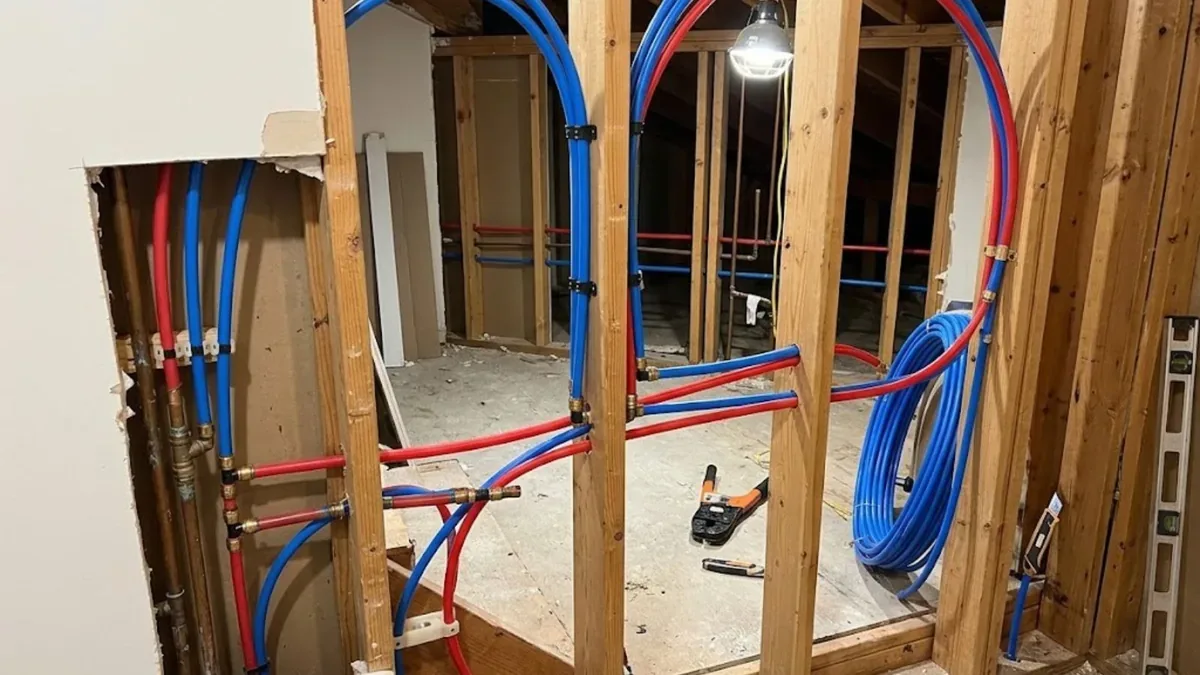
Repiping is rarely the first answer. A pinhole in one copper elbow is a repair. Brown water after a long absence is often a flushing job. A repipe in Plainsboro, NJ makes sense when the pipes themselves are failing along their length, not when one fitting is.
What brings people to this page is usually a symptom. Pinhole leaks that keep coming back, rusty or brown water from the tap, pressure that fades, or a plumber who has fixed the same line twice. Each of those can have a smaller cause, and a good plumber rules those out first.
Home era, the piping to look for, and what to check
Age gives a clue about what is in the walls, but only a look at the pipe confirms it.
| Home era | Piping you may find | What to check |
|---|---|---|
| 18th and 19th century (Plainsboro Village). | Mixed old lines, later copper and galvanized patches. | Where old and new meet, joints, shutoffs, any lead in the service pipe. |
| 1970s to early 1980s multifamily. | Often copper, sometimes galvanized on older runs. | Pinholes, green crust at joints, valves that no longer seal. |
| Mid-1980s to 1990s single-family. | Mostly copper, with plastic possible. | Fittings, pressure at the farthest tap, water heater connections. |
| 2000s and later. | Copper, PEX or CPVC. | Fittings and manifolds, UV damage, local freeze exposure. |
These are general patterns, not a promise about any one house. Ask the plumber to open an access point and look.
Spot repair or a new set of pipes?
One leak in a section of pipe that is otherwise healthy calls for a repair. The usual repair is cutting out the damaged piece and joining new pipe with a press fitting or a soldered coupling. This is much faster and cheaper than a repipe.
The decision shifts when leaks keep appearing at different spots on the same material, when the pipe wall is visibly thin, or when the water flow has dropped across the house. Three repairs in a year on the same line is a pattern. At that point, a repipe of the failing run, or the full house, starts to cost less than another round of repairs.
Signs that point toward replacement
One of these alone may be a repair. Several together mean it is time to ask about repiping.
- Pinhole leaks on more than one run, or the same line repaired more than once.
- Rusty or brown water that does not clear after running the tap for a while.
- Pressure that is poor at every fixture and does not improve when the regulator is checked.
- Gray, rough steel pipe visible in a basement, crawlspace or utility closet.
- Green, crusty corrosion on copper joints along several runs.
- Pipes that rattle or clank due to loose supports or narrowed lines.
- A plumber who finds thin walls when cutting into a section.
Replacing galvanized pipe
Galvanized steel is the usual reason people hear the word repipe. The zinc coating wears off, rust builds inside the pipe, and the opening narrows. Water comes out brown and weak. Because the corrosion is inside, a visible patch on the outside says little about the rest.
A galvanized run feeding the house is often replaced with copper or PEX in one job, so that new pipe is not joined to old. If you are unsure what the pipe is, scratch it with a coin. Shiny gray or silver metal means galvanized. A magnet will cling to galvanized steel but not to copper. Where the service line is galvanized, see water service line repair.
PEX or copper, and what each does well
PEX is flexible plastic tubing. It runs through walls with fewer joints, resists freeze splitting better than rigid pipe, and does not corrode. It can be damaged by sunlight and must not be run outdoors, and its fittings are the common weak point. Copper lasts a long time, handles heat, and is accepted everywhere, but costs more to buy and needs soldering or press fittings.
Neither is simply better. Copper suits visible runs and homes where the owner wants metal throughout. PEX suits retrofits where fishing pipe through finished walls would otherwise mean extensive demolition. The plumber should explain which one fits each part of your house, and why.
How a repipe job is planned
A good plan keeps the water off for as little time as possible.
Inspect and map
The plumber looks at the water entry, riser runs, fixtures and any visible pipe, then lays out a route.
Choose material and access
Copper or PEX is chosen, and access points are placed in closets, ceilings or behind fixtures to keep wall openings small.
Notify the township
Notice goes to the local enforcing agency before work begins, with a permit application filed within five business days.
Plan the shutoff days
Water is off for part of each work day. The plumber sets a schedule, and you store water for drinking and flushing.
Replace, test, patch
New pipe goes in, the system is pressure-tested and inspected, then walls are patched for painting.
Plainsboro housing: who really needs a repipe
Most Plainsboro homes date from the 1970s or later, according to the township's own Land Use Plan, which says multifamily construction dominated the 1970s and early 1980s and single-family homes followed. A whole-house repipe is therefore less common here than in older towns such as Princeton. For a condo or townhouse, a leak is often one fixture or riser, not the whole building.
The exception is Plainsboro Village, mapped as an R-85 zone of mostly detached homes, with buildings from the 18th century. A house that old has likely had piping added or replaced several times, so a complete plan may be worth it. In Walker-Gordon, where the R-90 zone was approved in 1988, expect newer systems and targeted repairs. For multifamily units, ask the association who owns the shared risers before planning work.
Permits and the plumbing code
New Jersey uses the National Standard Plumbing Code for plumbing work. Under N.J.A.C. 5:23-2.17A, replacing existing piping with new approved material of like capacity counts as minor work. That is not an exemption from permits. The owner or contractor gives notice to the local enforcing agency before work starts and files an application within five business days.
In Plainsboro the contact is the township Building Division on Plainsboro Road. If the job changes pipe sizes, adds fixtures or moves the water entry, ask the Building Division whether it falls outside minor work. Only a master plumber, an authorized plumbing contractor, or their W-2 employees may do the work, and you can verify a licence through the State Board of Examiners of Master Plumbers using the Division of Consumer Affairs License Verification System.
What goes into the price of a repipe
The price is set by how many fixtures, how much wall access and what pipe you choose.
Number of fixtures and floors
More bathrooms, kitchens and levels mean more pipe, more joints and more time.
Material
Copper costs more in material and labor than PEX for the same layout.
Wall and ceiling access
Finished walls need patching and painting, and plaster takes more work than drywall.
Permit and inspection
Notice, the permit fee and inspection are part of the work in Plainsboro.
Shared systems
In a condo or townhouse, board approval or building shutoffs can add steps and time.
Homeowners policies generally do not pay to replace worn pipe. Some cover water damage from a sudden burst, but not the cost of upgrading the plumbing. Ask your insurer what applies before you decide, and ask whether a repipe affects your premium.
Call to talk through your symptoms and get a clear price before work starts.
Call (609) 547-1417Repiping questions from Plainsboro homeowners
One leak on otherwise healthy pipe is a repair. Repeated leaks on different runs, brown water or thin pipe walls point to replacement.
Neither wins every time. PEX is easier to fish through finished walls, and copper suits exposed runs and owners who want metal. Ask the plumber to explain the choice for your layout.
Usually less than people expect. Access points are placed in closets, ceilings and behind fixtures, and patching comes afterward.
Like-for-like replacement is minor work under N.J.A.C. 5:23-2.17A. Notice goes to the enforcing agency first, and an application follows within five business days.
Typically for part of each workday, not the whole project, though the plan depends on the house. The plumber sets a schedule before starting.
They are likelier to have mixed or aging pipe, since some buildings date to the 18th century. An inspection is the only way to know. If a pipe has already burst, see burst pipe repair.
Yes. Leak detection can find where water is escaping, and that can show whether one spot or the whole system is failing.
Decide with the pipe in front of you
Call and a plumber can look at the material before you commit to a repipe.
Where we dispatch from
We send repiping crews across Plainsboro and the neighboring towns. Our base is 777 Scudders Mill Rd, Plainsboro, NJ 08536, and the map shows the surrounding towns we serve.